PodStreet Weekly
 Velocity Meter
 CX-O
 Cult of Brands
 Growth Glider
 Dear Brain
Away Owns 8% of Amazon Luggage After 12 Months
Away captured 8% of Amazon luggage market share in under 12 months, showing new marketplaces like TikTok Shop challenge D2C growth playbooks.
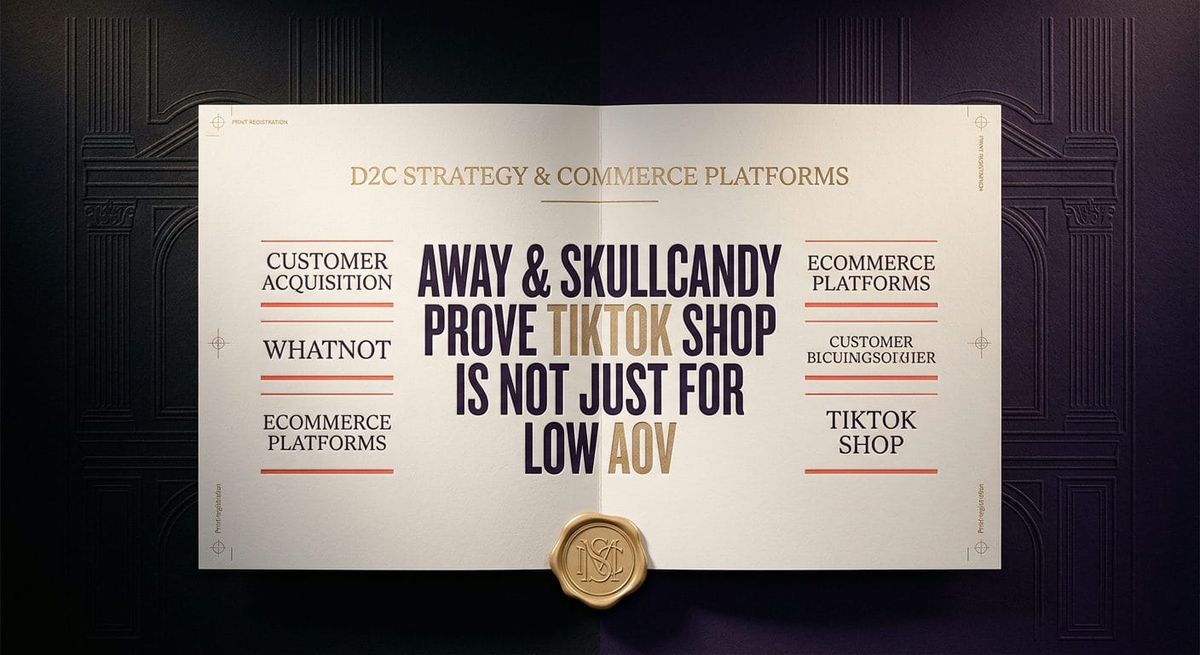
The brands winning today are mastering new pathways to demand – from live selling to AI-powered pages – while building cultural relevance and a lasting strategic moat.
The Intake
📊 10 episodes across 9 podcasts
⏱ 496 minutes of intelligence analyzed
🎙 Featuring: Taylor Holiday (Common Thread Collective), Evin Catlett (Skullcandy), Lucas Pachter (Tribe), Sean (Alia)
|
The Big Shift
The traditional playbook for D2C growth is evolving. Brands are demonstrating that the fastest path to cultural relevance and market share might not be through owned channels alone, but by strategically leveraging new marketplaces and emerging platforms like TikTok Shop and Whatnot, even for high-AOV products. This isn't just about sales; it's about demand generation and expanding the top of the funnel in previously untapped spaces, proving that consumer intent can be found and cultivated where few dared to look before.
Away, a brand synonymous with quality luggage, aggressively expanded into Amazon, Nordstrom, and TikTok Shop within 18 months under CEO Jessica Schinazi, who noted their strategy is "winning on the visibility, winning on the relevance, and just doing that with different tools that we have 10 years in." Their foray into TikTok Shop, for instance, drives new customer acquisition for their $400 full-price luggage, challenging the platform’s low AOV stereotype.
"When we joined on Amazon immediately, we captured that degree zero demand that was there so fast. And Today we own 8 to 9% of the Amazon market share in our category in less than 12 months."
— Jessica Schinazi, CEO of Away on The Operators
Similarly, Skullcandy, a 23-year-old brand with high-AOV headphones, found unexpected success on TikTok Shop, debunking assumptions about the platform's limitations. Evin Catlett, Global VP of Ecommerce and Growth Marketing at Skullcandy, highlighted that increasing the velocity of creators they worked with on TikTok Shop caused the platform to "absolutely take off for us and start to have real impact in sales and other channels as well." This points to a strategic imperative for brands to meet consumers where they are, transforming marketplaces into critical demand-generation engines that feed the entire omnichannel ecosystem, rather than solely relying on direct-to-consumer models.
The Rundown
① Sweepstakes Become Multi-Eight-Figure Growth Engines.
Ridge and HexClad are manufacturing demand and building significant lists through celebrity-backed sweepstakes, shifting perception of them from mere promotions to core growth strategies. (Connor MacDonald on Marketing Operators)
→ Strategic Insight: These campaigns serve as potent Q3 demand generators and customer acquisition channels, providing significant ROI beyond immediate sales by fueling email lists for key retail periods like BFCM.
② Loyalty Programs Must Prove Incrementality, Not Just Incentivize Existing Behavior.
Modern loyalty initiatives are pivoting from points-based systems to proving true incremental value, distinguishing new behaviors driven by the program from actions customers would have taken anyway. (Jacek Materna on Let's Talk Loyalty)
→ Actionable Intelligence: Brands need to rigorously measure incrementality, using A/B testing and holdout groups, to ensure their loyalty investments are driving new value rather than just rewarding pre-existing customer habits.
③ Micro-Influencers & Persona-Based Creative Unlock New Demand.
MyFitnessPal is scaling with 700 creative variations and a high-volume micro-influencer strategy to activate niche communities and create demand for the future, rather than just optimizing existing interest. (Jon Chang on Perpetual Traffic)
→ Opportunity Scan: Moving beyond large celebrity endorsements to hyper-targeted, persona-driven creative deployed via micro-influencers can build brand affinity and measurable word-of-mouth among specific communities, such as Gen Z.
④ AI-Powered Landing Page Generation Replaces Traditional Dev Times.
Nik Sharma details how brands can rapidly build high-converting landing pages using AI-driven tools, bypassing slow development cycles to tailor pages to specific audience angles and critical customer questions. (Nik Sharma on Limited Supply)
→ Operational Edge: Leveraging AI for modular landing page creation allows for agile hypothesis testing and optimized conversion paths for cold traffic, significantly outperforming generic homepages and collection pages.
⑤ Whatnot Emerges as a High-Intent, Low-CAC Live Selling Channel.
BattlBox scaled from $25K to $447K a month on Whatnot with zero ad spend, highlighting the platform's high buyer intent and AOV ($64) compared to TikTok Shop, and its unique community features. (John Roman on The Unofficial Shopify Podcast)
→ Channel Exploration: Brands seeking to diversify customer acquisition and leverage live selling should evaluate Whatnot for its organic reach and engaged community, recognizing that live selling proficiency requires a distinct skill set from pre-recorded content.
Signal Board
🔥 HEATING UP
• Whatnot: This live-selling platform is driving significant sales with zero ad spend for brands like BattlBox, signaling high buyer intent and AOV. (John Roman on The Unofficial Shopify Podcast)
• Sweepstakes as growth engine: Brands like Ridge and HexClad are using celebrity-backed sweepstakes to generate multi-eight-figure growth, acquire customers, and build email lists ahead of peak seasons. (Connor MacDonald on Marketing Operators)
• Unified brand and performance marketing: MyFitnessPal's strategy of running 700 creative variations and leveraging micro-influencers demonstrates effective integration for long-term demand creation. (Jon Chang on Perpetual Traffic)
👀 ON WATCH
• AI-powered Landing Page Generation: Nik Sharma is deploying custom AI tools (Codex, GitHub, Vercel) to rapidly build high-converting landing pages, bypassing traditional development bottlenecks. (Nik Sharma on Limited Supply)
• Incrementality in Loyalty Programs: The focus is shifting to measuring true behavioral lift, not just rewarding pre-existing customer actions, to ensure loyalty investments drive real value. (Jacek Materna on Let's Talk Loyalty)
• Neuro: This brand, born from a dorm room experiment, built a nine-figure business by creating a new product category and strategically navigating retail partnerships. (Kent Yoshimura on Shopify Masters)
❄️ COOLING OFF
• Loyalty program ≠ loyalty: A contrarian view suggests that loyalty programs often just pay for behaviors that would happen anyway, failing to inherently create genuine customer loyalty. (Jacek Materna on Let's Talk Loyalty)
• TikTok Shop influencer skills do not translate to Whatnot live selling: Brands are learning that success in short-form content does not guarantee success in unscripted, long-form live selling. (John Roman on The Unofficial Shopify Podcast)
The Debate
The fashion industry is grappling with how to balance artistic vision with commercial viability, particularly amidst a wave of creative director changes.
🐂 The Case For Independent Thinking: Imran Amed, Founder and CEO of The Business of Fashion Podcast, argues for a "renaissance of independent designers and independent thinking" as a counter to the "giantism" and quarterly pressures facing large groups. He suggests that private ownership, like Chanel's, allows for a long-term creative vision prioritizing quality over market demands. He also noted, "I think giantism because we're entering a period where I think people just want this kind of human scale, you know, human connection, human touch."
🐻 The Case For Commercial Acumen: Robert Williams, Chief Luxury Correspondent at The Business of Fashion Podcast, emphasizes that while "there needs to be some kind of a formula," brands "need to always make sure they're investing in having new ideas." He points to Chanel's Matthieu Blazy achieving a 16% sales increase, suggesting that creative shifts must eventually translate to commercial success to justify their strategic importance within large luxury houses.
The Strategist's Take: The most sustainable path for luxury brands involves integrating bold, independent creative vision with a clear, commercially intelligent strategy, understanding that true innovation must eventually resonate with the market.
The Bottom Line
The brands truly building enduring value are the ones actively seeking, testing, and scaling new channels and tools to cultivate demand, rather than waiting for customers to find them.
Channel Check
📱 Digital Marketplaces
Both Away and Skullcandy are aggressively embracing TikTok Shop and Amazon, not just for sales but as critical top-of-funnel customer acquisition channels, challenging previous assumptions about AOV limitations on these platforms. BattlBox’s success on Whatnot further solidifies the role of specialized live-selling platforms as potent, low-CAC growth engines.
⚙️ AI & Automation
The conversation around AI is shifting from theoretical potential to practical, brand-owned implementation. Nik Sharma demonstrates how AI can rapidly generate tailored landing pages, while MyFitnessPal is using AI-informed creative diversification at scale. The emphasis is on building proprietary AI data infrastructure to avoid commissions and leverage compounding benefits.
👑 Brand & Loyalty
Loyalty programs are under scrutiny to prove true incrementality, moving beyond merely rewarding existing behaviors. Brands are also learning that genuine brand equity, often built through unexpected partnerships like Neuro's with Kind Bar's founder, or through strategic celebrity sweepstakes, is essential to cut through AI-driven content saturation.
Quick Appendix
The Operators: "Away’s CEO & New DTC Playbook: Amazon, TikTok Shop, and 300% Over Plan" · 89 min · Featuring Jessica Schinazi ▶ Listen
The Business of Fashion Podcast: "How Independent Thinking Powered the Spring/Summer 2027 Shows" · 69 min · Featuring Imran Amed ▶ Listen · Apple Podcasts
The Business of Fashion Podcast: "The Verdict on Luxury Fashion’s Designer Reset" · 37 min · Featuring Sheena Butler-Young ▶ Listen · Apple Podcasts
Ecommerce Playbook: Numbers, Struggles & Growth: "Skullcandy Is Building Black Friday Demand With TikTok Shop" · 30 min · Featuring Evin Catlett ▶ Listen · Apple Podcasts
Let's Talk Loyalty: "TrueLoyal: Building Loyalty That Creates Incremental Value (#807)" · 58 min · Featuring Jacek Materna ▶ Listen · Apple Podcasts
Limited Supply: "Build a Q4 Landing Page With AI" · 33 min · Featuring Nik Sharma ▶ Listen · Apple Podcasts
Marketing Operators: "HexClad + Ridge Reveal Their 8-Figure Celebrity Sweepstakes Playbook" · 58 min · Featuring Connor MacDonald ▶ Listen · Apple Podcasts
Perpetual Traffic: "The Unified Marketing Strategy Behind MyFitnessPal's 220 Million Users" · 48 min · Featuring Jon Chang ▶ Listen · Apple Podcasts
Shopify Masters: "How Two Founders Turned a Dorm Room Experiment Into a Nationwide Retail Brand" · 31 min · Featuring Kent Yoshimura ▶ Listen · Apple Podcasts
The Unofficial Shopify Podcast: "From $25K to $447K a Month: BattlBox's Whatnot Playbook" · 43 min · Featuring John Roman ▶ Listen · Apple Podcasts
Topics