PodStreet Weekly
 Velocity Meter
 CX-O
 Cult of Brands
 Growth Glider
 Dear Brain
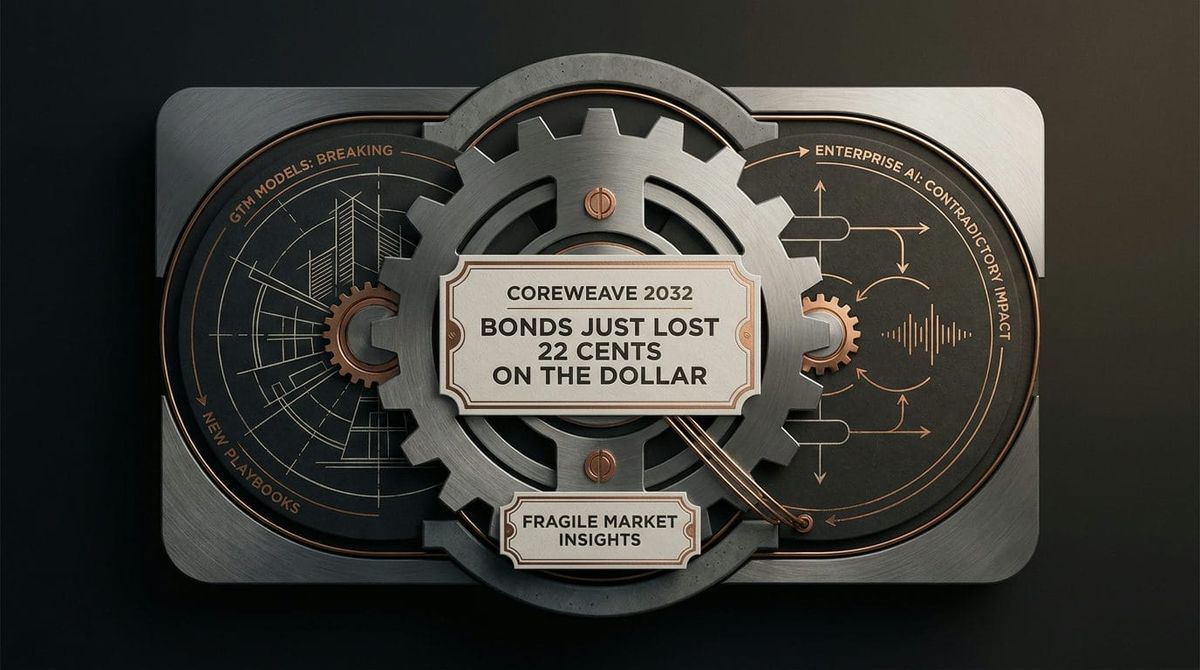
Core Weave 2032 Bonds Just Lost 22 Cents on the Dollar
Core Weave's 2032 bonds plummeted to 78 cents, signaling significant default risk for the AI infrastructure firm amid industry challenges from compute costs and open-source models.
This Week
Scanned: 314 episodes across 176 shows. Surfaced: 33 threads.
The Forecast
Core Weave May Face a >50% Default Risk Within Five Years
The bond market is signaling significant trouble for AI infrastructure company Core Weave. A speaker on Bankless forecasts that the company might have a greater than 50% chance of default in the next five years, pointing to how its 2032 bonds have collapsed from par to just 78 cents on the dollar.
...this implies that core weave might have a greater than 50% chance of default in the next five years.— Speaker, Bankless
This concern was not an isolated one; nine distinct shows carried this thread. Coverage on CNBC's "Fast Money" noted Core Weave's bonds have fallen into distressed territory with yields surging above 15%. On Unhedged, its credit default swaps were reported trading at 1100 basis points, a figure that implies, as calculated on All-In with Chamath, Jason, Sacks & Friedberg, about a 55% chance of a default.
The Rundown
① AI Giants Raise Over $250 Billion in Debt, Crowding Out Other Markets
Ted Mortonson on Bloomberg Surveillance noted that the massive proposed debt raises from companies like Anthropic and OpenAI are already siphoning investment from other fixed-income assets.
→ What to watch: Whether the debt market can sustain this level of AI-related fundraising without significant distortion to other asset classes.
② AI's True Cost Is Measured in Results, Not Tokens
The focus is shifting from raw token prices to the total cost of achieving a specific outcome, argued Iskander Malikov on Eye On A.I.
→ What to watch: If companies move from tracking token consumption to measuring cost-per-outcome, changing how AI value is defined and sold.
③ Open-Source Models Challenge the AI Frontier Duopoly
On The a16z Show, Lisha Li explored how open-model labs, particularly in China, are proving remarkably capable of keeping pace with closed-source leaders like OpenAI and Anthropic.
→ What to watch: Whether rapid innovation in open models can overcome the structural compute and capital advantages held by the frontier AI giants.
④ Bank of America's Remediation Costs Top Hundreds of Millions
CEO Brian Moynihan disclosed spending over a couple hundred million dollars on remediation for anti-money laundering orders, as reported by Rich Strofalino on Cybersecurity Headlines.
→ What to watch: How the massive fine and remediation efforts impact the bank's tech strategy and its spending on compliance versus innovation.
For You
If you're a Founder → Four shows this week tracked the AI model arms race, with Mustafa Suleyman telling staff—as heard on The AI Daily Brief: Artificial Intelligence News and Analysis—that his team built a model stronger than GPT 5.6 using just a quarter of the compute. For founders, the race isn't just about raw power; it's about proving you can innovate with superior capital efficiency and algorithmic cleverness.
If you're an Operator → The real-world impact on productivity was a theme on five shows, as Zoetis CIO Keith Sarbaugh reported a "30, 35 ish percent productivity improvement" for developers using AI assistants on Technovation with Peter High (CIO, CTO, CDO, CXO Interviews). For operators, this signals a shift from simply deploying tools to instrumenting and managing AI's impact on P&L, turning productivity gains into measurable financial outcomes.
If you're an Investor → Four shows debated AI's outsized economic impact, with Bill Eigen cautioning on Animal Spirits Podcast that AI capex may have accounted for almost half of last quarter's GDP growth. For investors, this frames the central tension: while AI spending is driving the market, its concentration creates significant systemic risk if the investment cycle turns.
If you're a Builder → The human cost of AI was a concern across five shows, as Sherry Turkle on The Ezra Klein Show warned of a new "Gilded Age class of AI overlords" whose goal is to create interactions that limit human potential. For builders, this is a direct challenge to consider the second-order effects of your work and the ethical guardrails needed to build technology that elevates, rather than diminishes, its users.
Press Play
- The Ezra Klein Show — A powerful caution on the human cost of AI convenience. Sherry Turkle argues we’re being lulled by a new class of tech titans. “...you have now a kind of Gilded Age class of AI overlords where the plan is to create more of that...” (Sherry Turkle) Listen →
- Clarity — Dr. Gleb Tsipursky quantifies the career upside of AI, citing a PwC study showing professionals with relevant AI skills command a 69% wage premium. (Dr. Gleb Tsipursky) Listen →
- Bloomberg Surveillance — Ted Mortonson connects the AI boom to the bond market, explaining how over $250 billion in proposed funding for companies like OpenAI and Anthropic is already crowding out other asset classes. (Ted Mortonson) Listen →
From the Network
What else went out across the network this week.
- Velocity Meter — Jordan Peterson Says Bravery, Not Safety, Is True Security
- Growth Glider — Kristie Jones Says AI Elevates Human Judgment and Critical Thinking
- CX-O — Why Did Bread Financial Reduce Debt 70 Percent?
- Cult of Brands — Plus Company Says Outcome Models Are Not a Myth
|
Subscribe
Curiosity piqued? Get more insights directly in your inbox every week.
Subscribe to The Weekly Roundup →
Share
Bonds bought at par four months ago now trade at 78 cents, implying Coreweave might have a greater than 50% chance of default in the next five years.
Topics