PodStreet Weekly
 Velocity Meter
 CX-O
CX-O Cult of Brands
 Growth Glider
 Dear Brain
3.4 Million Downloads and Your Analytics See None
Autonomous AI agents reshape marketing and purchasing by bypassing traditional analytics, demanding new demand capture and brand building strategies.
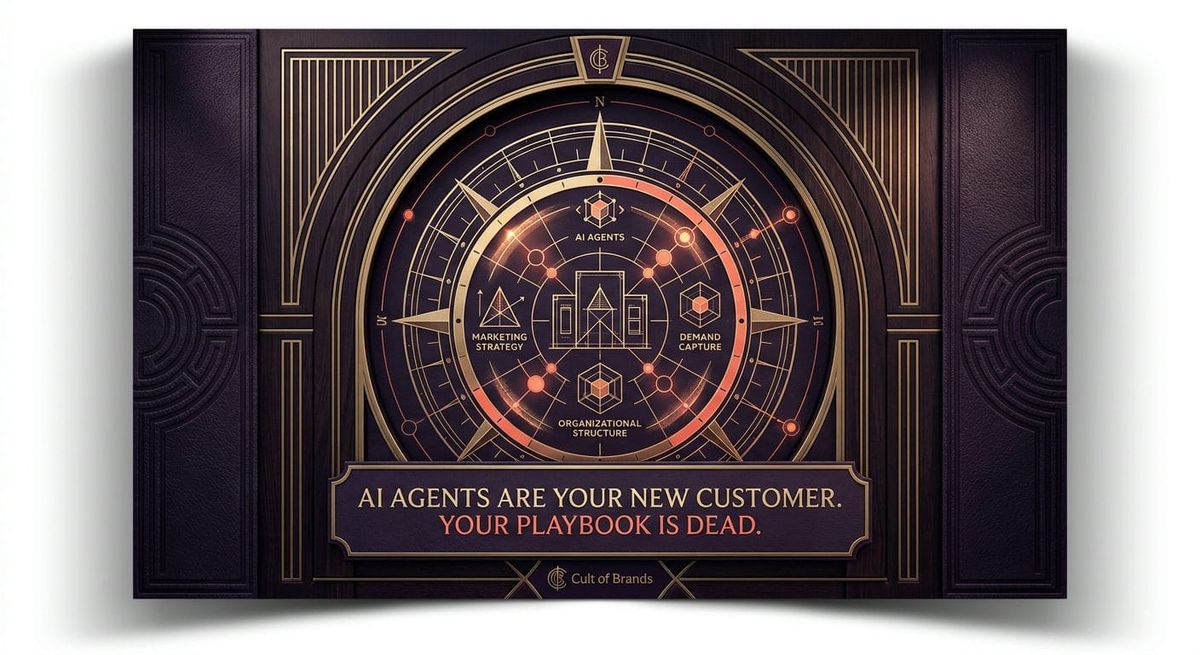
The rise of the AI agent isn't just another technological shift; it's a fundamental re-architecting of who your customer is, demanding a radical re-evaluation of marketing's entire demand capture playbook.
The Intake
📊 10 episodes across 9 podcasts
⏱ 392 minutes of intelligence analyzed
🎙 Featuring: Kipp Bodnar (Hubspot Media), Kieran Flanagan (Hubspot Media), Joe McCambley (Saatva), Elena Jasper (Marketing Architects)
|
One Big Thing
The foundational assumption of marketing—that you are always selling to a human—is crumbling under the weight of autonomous AI agents. This isn't a future prediction; it's a present reality where your next "website visitor" is an AI with a credit card, fundamentally reshaping demand capture and brand building.
The New Customer: AI agents like Meta's Muse 🆕, Instinct 🆕, and Grokbot 🆕 are now browsing, comparing, and making purchases, with Instinct 🆕 already driving billions in gross merchandise value (GMV). Kipp Bodnar, Host at Hubspot Media, starkly articulated this shift, stating, "Your next website visitor isn't a person. It's an AI agent with a credit card."
"Meta's Muse hit 3.4 million downloads and is the number one app in the Apple App Store in under three weeks. It browses from its own computer and shows up nowhere in your analytics."
— Kipp Bodnar, Host at Hubspot Media on Marketing Against The Grain
The Broken Playbook: These proactive agents, with memory, preferences, and access to tools, are bypassing traditional demand capture funnels. Kieran Flanagan, Host at Hubspot Media, emphasized, "The most disruptive thing is going to be AI agents doing the buy in," making the "capture the demand world" playbook fundamentally broken. This necessitates a dramatic pivot from traditional SEO, SEM, and performance marketing, as agents prioritize verifiable data and transparent information over promises.
Why it matters: Marketers must shift investment upstream to higher-funnel brand awareness and focus on Validation and proof over promises in marketing 🆕. Joe McCambley, CMO of Saatva, provided a compelling parallel by highlighting how Saatva's investment in upper-funnel brand building, driven by statistical analysis, directly led to measurable increases in branded search and market share. The new imperative is to be discoverable and credible to these autonomous entities, not just humans. This means clear pricing, accessible case studies, and robust customer advocacy become paramount, as AI agents will actively lower switching costs by migrating data and comparing alternatives.
The Rundown
① AI-Driven Marketing Teams Need "Exploratory Pods" to Find New Opportunities.
As AI automates rote tasks, marketing organizations must shift from traditional hierarchical structures to agile "pod models" featuring "zero-to-one marketers" who leverage personal AI stacks to discover new growth opportunities, rather than having less experienced marketers focus on unimportant tasks. (Kipp Bodnar on Marketing Against The Grain)
→ The Implication for CMOs: Re-evaluate your organizational structure to foster exploratory teams that can experiment with new market opportunities and integrate AI as a core capability, freeing specialists for high-impact creative work.
② Brand Building, Not Just Performance, is Essential for Enduring Growth.
Saatva, initially performance-focused, significantly increased branded search and market share by investing in upper-funnel brand building, overcoming internal resistance with WARC research and rigorous statistical analysis to prove ROI. (Joe McCambley on The Marketing Architects)
→ The Implication for CMOs: Advocate for a balanced 50/50 budget split between performance marketing and long-term brand building 🆕, using data-driven arguments to demonstrate how brand investment correlates with measurable business outcomes like market share and reduced CAC.
③ Programmatic Advertising Still Suffers from Significant Waste Without Transparency.
Up to 25% of programmatic ad spend is wasted on ineffective impressions, often on Made-for-Advertising (MFA) sites, largely due to the lack of log-level data for advertisers. (Bob Liodice on CMO Confidential)
→ The Implication for CMOs: Demand log-level data from your programmatic partners and scrutinize your media buys to ensure transparency and eliminate waste, recognizing that a significant portion of your budget may be underperforming.
④ Trust is the Most Critical Strategic Asset in Regulated Industries.
Reagan Greene, VP of Marketing and Experience at Blue Cross of Idaho, highlighted that in healthcare, where consumers engage in vulnerable situations, building and maintaining trust is paramount for both loyalty and growth. (Reagan Greene on The CMO Podcast)
→ The Implication for CMOs: Prioritize trust-building initiatives and transparent communication, especially in regulated or sensitive sectors, recognizing that consumer confidence directly translates to long-term loyalty and competitive advantage.
⑤ Strategic Trade-offs in B2B Marketing Drive Accelerated MQL-to-Opportunity Conversion.
Canoe Intelligence doubled its MQL-to-opportunity conversion rate by focusing on speed, integrating marketing with sales processes, and leveraging automation for rapid, contextualized follow-ups. (Betsy Daitch on Renegade Marketers Unite)
→ The Implication for CMOs: Identify and eliminate bottlenecks in your lead-to-pipeline process, particularly by improving the speed and relevance of sales follow-ups, to dramatically increase conversion rates and pipeline velocity.
Signal Board
🔥 Heating Up
• Pod model (for team organization): Marketing teams are shifting from traditional hierarchies to agile, mission-driven pods for better velocity and leverage. (Kipp Bodnar on Marketing Against The Grain)
• AI-Pilled Marketer / Super IC / Zero-to-one marketer: The emergence of individual contributors leveraging personal AI stacks for end-to-end marketing tasks. (Kieran Flanagan on Marketing Against The Grain)
• Brand building and resilience through 'stepping into the punch': Investing in upper-funnel activities to reduce long-term CAC and build brand equity. (Joe McCambley on The Marketing Architects)
• Community engagement as a competitive advantage for local brands: Local brands leveraging community involvement and sports sponsorships to build trust and drive growth. (Reagan Greene on The CMO Podcast)
• Human creativity vs. AI in marketing strategy: Human oversight remains critical to avoid brand "sameness" in AI-driven campaigns. (Jon Hyman on The Agile Brand with Greg Kihlström®)
🆕 On Watch
• Meta's Muse 🆕: A personal AI agent that rapidly achieved 3.4 million downloads, indicating a massive shift in how consumers will interact with brands. (Kipp Bodnar on Marketing Against The Grain)
• Validation and proof over promises in marketing 🆕: AI agents prioritize verifiable data and transparent information, making traditional messaging less effective. (Kipp Bodnar on Marketing Against The Grain)
• Practical AI applications in publishing (yield management, transcription, voice, conversion) 🆕: Publishers like The New York Times are implementing AI for operational efficiency and monetization. (Courtney Glaze on AdExchanger)
• Dentsu's market position and growth challenges 🆕: The agency holding company is facing scrutiny over its growth outside Japan and its ability to win major accounts. (Bergi on The Digiday Podcast)
• Braze AI Operator 🆕: Braze's AI agent can fully operate its dashboard, hinting at a future where AI manages campaign execution end-to-end. (Jon Hyman on The Agile Brand with Greg Kihlström®)
❄️ Cooling Off
• Hyper-targeting individual consumers: Considered a "complete waste of time" by some, arguing for broader reach to discover new audiences. (Joe McCambley on The Marketing Architects)
• Traditional marketing strategies becoming obsolete due to AI agents: The playbook for demand capture is "fundamentally broken" as AI agents become primary buyers. (Kipp Bodnar on Marketing Against The Grain)
• Traditional positioning and slogans are ineffective with AI agents: Agents prioritize factual validation over creative messaging, rendering traditional taglines less impactful. (Kipp Bodnar on Marketing Against The Grain)
The Tension
The marketing industry is grappling with whether to prioritize broad reach advertising for audience discovery or hyper-targeted individual consumer marketing.
🏛️ The Status Quo Doctrine: For years, the prevailing wisdom has been to leverage data for increasingly precise, individually tailored targeting. The promise is efficiency: reaching the right person with the right message at the right time. This approach is rooted in the belief that personalized journeys and managed buying paths maximize conversion.
🚀 The Challenger Doctrine: Joe McCambley, CMO of Saatva, posits a contrarian view, stating that efforts to target individual consumers and manage the buying journey are "often a complete waste of time" on The Marketing Architects. He advocates for broader advertising to discover unexpected valuable audiences, citing Saatva's success with millennials via low-cost linear TV buys. This doctrine suggests that marketers should cast a wider net, allowing the market to reveal new segments rather than pre-defining them.
The Advisor's Read The weight of evidence from Saatva's experience suggests that while hyper-targeting has its place, a broader reach can uncover new, valuable customer segments, especially when combined with rigorous measurement, forcing a re-evaluation of current budget allocations.
The Bottom Line
Your next customer is an AI agent, and if your strategy isn't built for that reality, you're playing yesterday's game.
Toolkit
Diagnostic for AI-Ready Marketing Teams
To assess your organization's readiness for the AI agent era and the evolving marketing landscape, consider these diagnostic questions:
- Organizational Structure: Is your marketing team designed with agile "pod models" and "exploratory teams" that can quickly identify and scale new opportunities, or is it rigid and hierarchical?
- Budget Allocation: Do you have a strategic, data-backed rationale for your brand vs. performance marketing split, or is it based on historical precedent or short-term pressures?
- AI Integration: Are you actively deploying AI to automate rote tasks and free up human marketers to "dig for oil," or are you merely using AI as a "prompt and response calculator"?
- Brand Credibility: Is your brand's value proposition, pricing, and product information transparent, verifiable, and easily consumable by autonomous AI agents, or does it rely on traditional, human-centric messaging?
- Talent Development: Are you nurturing "AI-pilled marketers" and "zero-to-one marketers" who can leverage personal AI stacks, or is your team lacking the skills to operate in an AI-first environment?
— Insights from Kipp Bodnar & Kieran Flanagan on Marketing Against The Grain and Joe McCambley on The Marketing Architects
Quick Appendix
Marketing Against The Grain: "HubSpot Execs: What Marketing Teams Look Like in 2027" · 31 min · Featuring Kipp Bodnar ▶ Listen · Apple Podcasts
For the CMO who needs to: Redesign their marketing organization to leverage AI and foster a culture of innovation and continuous growth.
The Marketing Architects: "The Physical Laws of Marketing with Joe McCambley, CMO of Saatva" · 41 min · Featuring Joe McCambley ▶ Listen · Apple Podcasts
For the CMO who needs to: Justify brand building investment to the board with rigorous statistical analysis and challenge conventional wisdom on targeting.
The Digiday Podcast: "Which Golden Girl is WPP most like?" · 43 min · Featuring Kamiko McCoy ▶ Listen · Apple Podcasts
For the CMO who needs to: Understand the competitive dynamics of the major ad agency holding companies and how client shifts impact their market positioning.
CMO Confidential: "Bob Liodice | 31 Years, 1 Industry: Bob Liodice Looks Back and Shares His Future Perspective: Part 2" · 30 min · Featuring Bob Liodice ▶ Listen · Apple Podcasts
For the CMO who needs to: Grasp critical issues like media transparency, budget allocation, and the evolving agency landscape from an industry veteran's perspective.
That's What I Call Marketing: "TWICM 218: The Singles: Grindr IRL with Madonna, ON taking On Nike, Walkers Little Moments of Joy" · 28 min · Featuring Conor Byrne ▶ Listen · Apple Podcasts
For the CMO who needs to: See how diverse brands are tackling growth and salience through community building, strategic partnerships, and brand refresh campaigns.
Renegade Marketers Unite: "539: Pick Your Battles: Strategic Trade-offs in B2B Marketing" · 51 min · Featuring Drew Neisser ▶ Listen · Apple Podcasts
For the CMO who needs to: Master strategic prioritization, accelerate MQL-to-opportunity conversion, and effectively integrate AI into B2B marketing workflows.
The CMO Podcast: "Healthcare Is Personal: Blue Cross of Idaho’s Reagan Greene on Trust, Growth & Experience" · 61 min · Featuring Reagan Greene ▶ Listen · Apple Podcasts
For the CMO who needs to: Understand how to build trust as a strategic asset and drive growth through community engagement in regulated industries.
The Agile Brand with Greg Kihlström®: Expert Mode Marketing Technology, AI, & CX: "Braze CTO Jon Hyman on where marketing judgment sits when AI runs the campaign" · 25 min · Featuring Jon Hyman ▶ Listen · Apple Podcasts
For the CMO who needs to: Explore the cutting edge of AI-driven customer engagement platforms and balance human creativity with autonomous campaign execution.
Marketing Against The Grain: "We Tested What AI Personal Assistants Can Actually Do" · 36 min · Featuring Kipp Bodnar ▶ Listen · Apple Podcasts
For the CMO who needs to: Confront the immediate implications of AI agents as customers and fundamentally rethink their demand capture and brand validation strategies.
AdExchanger: "Value Over Volume, With NYT's Courtney Glaze" · 46 min · Featuring Alison Schiff ▶ Listen · Apple Podcasts
For the CMO who needs to: Understand how premium publishers like The New York Times are leveraging first-party data, AI, and strategic partnerships for sustainable monetization.
Topics