PodStreet Weekly
 Velocity Meter
 CX-O
CX-O Cult of Brands
 Growth Glider
 Dear Brain
CMOs Are Now Hiring AI with Job Descriptions
CMOs move beyond AI adoption, integrating humans and digital agents to redesign marketing operations, unlocking systemic efficiencies and strategic agility.
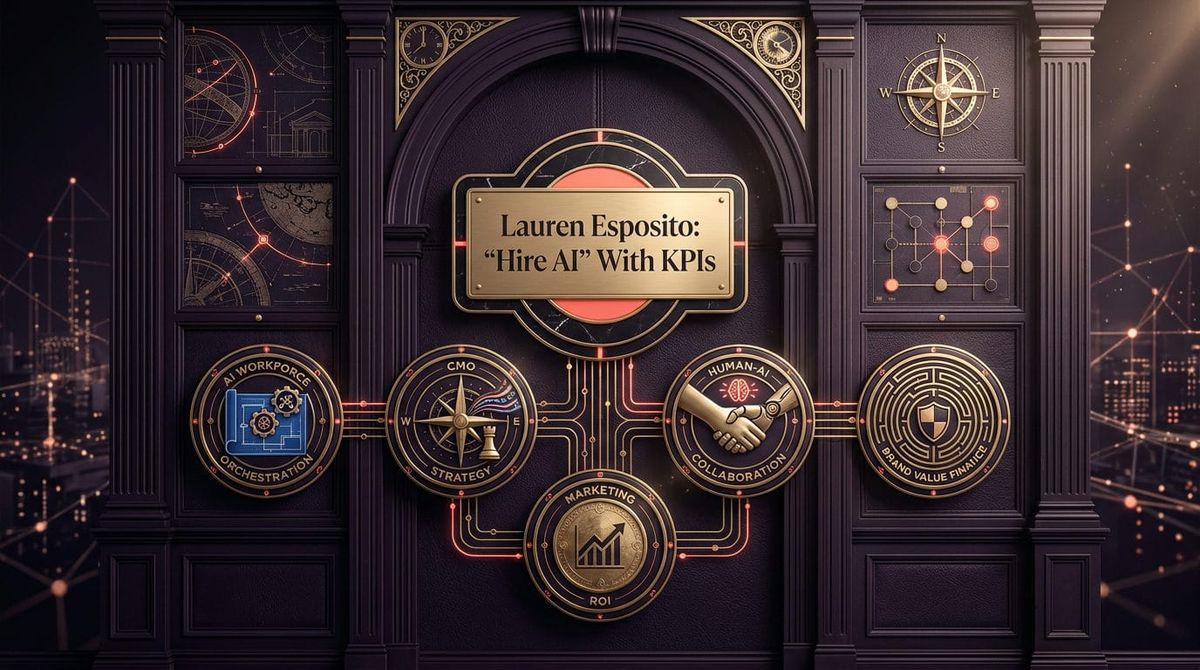
The CMO mandate is no longer to drive marketing efficiency, but to architect the enterprise for durable growth, where AI becomes an ally in orchestrating human and digital workforces, and financial acumen unlocks brand investment.
📊 10 episodes across 10 podcasts
⏱ 344 minutes of intelligence analyzed
🎙 Featuring: Lauren Esposito (CMO, Asymbl), John Wall (Host, Marketing Over Coffee), Christopher Penn (Host, Marketing Over Coffee), Stephen Houraghan (Host, Brand Master Podcast)
|
One Big Thing
The strategic imperative for CMOs is shifting from merely adopting AI to orchestrating an integrated workforce of humans and digital agents. This isn't about using AI as a tool, but about redesigning the operational fabric of the business, particularly within marketing, to unlock systemic efficiencies and strategic agility. The shift demands that CMOs think like architects, defining outcomes and then building the hybrid teams, systems, and metrics to achieve them, rather than focusing on isolated AI use cases.
The Opportunity: AI, when approached as "digital workers," offers a pathway to unprecedented automation and focus. Lauren Esposito, CMO of Asymbl, details how companies are now applying a mindset of "let's hire AI, let's give it job descriptions, key motivations for success, a manager, KPIs that we're going to measure it against" on Marketing Over Coffee. This frames AI not as a feature, but as a component of a workforce that needs to be managed, measured, and integrated into existing business processes. This is critical for CMOs aiming to move beyond tactical deployments to strategic enterprise-wide impact.
"A lot of people come in with a use case and we say, let's back up. What's the outcome? It's not that I want an SDR agent on my website, right. And that's okay, that's a use case. But what is it that you want that SDR agent to do?"
— Lauren Esposito, CMO of Asymbl on Marketing Over Coffee Marketing Podcast
Why it matters: This workforce orchestration model enables hyper-personalization at scale, treating each customer as a "customer of one" by activating vast amounts of data, as Sam Allen, CEO of Iterable, highlighted on Marketing Vanguard. It addresses the growing pressure on CMOs to demonstrate clear ROI on AI investments by linking technology adoption directly to measurable business outcomes. Furthermore, this approach forces a "brain first, tool second" mindset (David Epstein on Marketing Against The Grain), mitigating the risk of "credibility debt" from over-automated, low-quality output (Daniel Sills on The Marketing Architects). CMOs who lead this orchestration redefine marketing as a critical growth engine rather than a mere cost center, aligning their strategic contributions with the P&L.
The Rundown
① Finance Leaders See Brand as an Enterprise Asset, Often More Than Marketers Do.
The "Confident B2B Marketer Study" reveals that finance leaders are often more confident in the value of creativity and brand than marketers themselves. Daniel Sills (Vice President of Brand Partnerships, NewtonX) and Dagmara Szulce (Group Executive Vice President, Association of National Advertisers (ANA)) on The Marketing Architects emphasize that "Finance is not standing in between you and brand investment... What they want you to do is translate what you're doing into the economics of growth when it comes to brand."
→ The Implication for CMOs: Stop defensively justifying brand spend; instead, proactively translate brand value into the language of enterprise economics, co-creating metrics with CFOs to secure investment.
② Strategic Positioning in B2B Demands Cross-Functional Co-Creation, Not Marketing Isolation.
April Dunford (Author of 'Obviously Awesome' and 'Sales Pitch', Positioning Consultant) on Brand Master Podcast asserts that B2B positioning developed solely by marketing "never survives" because sales teams won't use it if they weren't involved in its creation. Effective positioning requires collaborative development with sales, product, and leadership, leveraging frontline expertise to challenge assumptions and ensure real-world resonance.
→ The Implication for CMOs: Embed sales and product leaders in the positioning process from day one, testing new pitches with qualified prospects to build alignment and ensure practical application for revenue teams.
③ Publishers' Public Posturing About Blocking Google Masks Their Deep, Enduring Reliance.
Despite public threats, many executives at large digital publishers privately admit they are "not that close" to actually blocking Google crawlers, highlighting the significant traffic loss experienced by past attempts (Sara Guaglione, Senior Media Reporter, Digiday on The Digiday Podcast). The conversation around publishers potentially blocking Google from crawling their content is more political than practical.
→ The Implication for CMOs: Understand the strategic implications of platform dependence; public statements can be tactical positioning, but fundamental business reliance often dictates actual behavior, demanding more robust diversification and direct audience relationships.
④ Brands Are Harnessing 'Cultural Hijacking' and Creative Constraints to Maximize Sponsorship ROI.
Heineken's CMO, Ali Payne, explains on Uncensored CMO how they became the 'Official Beer of Soccer' without being an official World Cup sponsor, leveraging cultural moments and creative constraints to drive disproportionate impact. Payne notes, "Sometimes not being the official sponsor forces you down to be super creative."
→ The Implication for CMOs: Reframe budget constraints as creative opportunities, exploring how to leverage cultural relevance and "earned" moments to amplify brand presence and achieve objectives without direct sponsorship costs, emphasizing activation spend over upfront fees.
⑤ The Power of 'Nice Working' Over Networking Drives Exponential Career and Business Growth.
Linda Kaplan Thaler (Legendary Advertising Executive, Author, Speaker, Kaplan Thaler Group (Co-founder)) on On Brand with Nick Westergaard attributes her agency's rapid growth to a 'power of nice' culture and "nice working," where "Every time you do something nice for somebody, it's a positive imprint. And that positive imprint is like a seed, and it's going to grow in ways that you can't imagine."
→ The Implication for CMOs: Cultivate an organizational culture grounded in genuine collaboration and reciprocity, recognizing that long-term relationships and positive interactions are a more durable engine for growth and career advancement than transactional networking.
Signal Board
🔥 Heating Up
• Workforce Orchestration: Businesses are "hiring AI" as digital workers, complete with job descriptions and KPIs, managed by platforms like Mulesoft to create hybrid human-AI teams (Lauren Esposito on Marketing Over Coffee Marketing Podcast).
• B2B Marketer Confidence: Confidence among B2B marketers in measuring financial impact has risen to 39%, yet a significant "vocabulary gap" remains with finance leaders (Daniel Sills and Dagmara Szulce on The Marketing Architects).
• Strategic Centering: Companies are achieving greater long-term value by intensely focusing on a core strategy and value proposition, rather than maintaining diverse, stable businesses (Rita McGrath on Renegade Marketers Unite).
• Heineken: The brand's strategic use of "cultural hijacking" (e.g., 'Official Beer of Soccer') and innovation in non-alcoholic beer demonstrates a potent blend of brand legacy and cultural relevance (Ali Payne on Uncensored CMO).
👀 On Watch
• AI search impact on publishers: Publishers' frustration with Google's AI Overviews, which use their content without adequate compensation, is leading to public threats of blocking crawlers, despite internal hesitation (Sara Guaglione on The Digiday Podcast).
• Marketing partnership between Heineken and Heinz 🆕: A unique collaboration born from observing consumer habits, highlighting the power of culturally resonant marketing (Ali Payne on Uncensored CMO).
• Most Interesting Man in the World campaign 🆕: The successful revival of Dos Equis' iconic campaign, leveraging enduring resonance with younger audiences (Ali Payne on Uncensored CMO).
• Non-alcoholic beer market expansion (Heineken): Heineken 0.0's success in appealing to women and broader audiences, expanding consumption occasions for beer (Ali Payne on Uncensored CMO).
❄️ Cooling Off
• AI as GPS for your brain: Over-reliance on AI for critical thinking is causing "slop marketing" and "credibility debt," advocating for a "brain first, tool second" approach (David Epstein on Marketing Against The Grain).
• Featuritis: The tendency to constantly add features, leading to project delays and complexity, is being countered by strategies like "design freezes" and enforced resource constraints (David Epstein on Marketing Against The Grain).
The Tension
The tension lies in how CMOs should approach AI: as a wholesale replacement for human tasks or as a strategic augmentation of critical thinking.
🏛️ The Status Quo Doctrine: Automated Efficiency at Scale: Many marketers view AI as the ultimate tool for scalable content creation and personalized communication, driving efficiency by automating repetitive tasks. This leads to heavy investment in generative AI tools for rapid output. Daniel Sills on The Marketing Architects warns that "There's a lot of marketers that are building a lot of credibility debt with their audience by automating their marketing by thinking, you know what, let's just throw it through Claude and We have a LinkedIn post every day." This perspective prioritizes volume and speed, often at the expense of quality and authenticity, with the belief that AI can independently manage vast marketing functions.
🚀 The Challenger Doctrine: AI as a Critical Thinking Partner: A counter-view posits that AI's true power is unleashed when used to enhance human judgment and creativity, not replace it. David Epstein on Marketing Against The Grain emphasizes a "brain first, tool second" approach, noting that his primary use of AI is to critique and refine his own writing, acting as a "critical editor" rather than a content generator. Similarly, Sam Allen, CEO of Iterable, states, "If you just turn over your marketing, your brand to an AI agent, you're going to end up in a lot of trouble, even if you do it within the confines of your own existing data set because it lacks context." This doctrine advocates for marketers to use AI to interrogate data, understand recommendations, and sharpen strategic insights, preserving human context and critical thinking.
The Advisor's Read: The effective CMO will adopt the challenger doctrine, leveraging AI to augment strategic thinking and decision-making while closely orchestrating its deployment to preserve brand integrity and build rather than erode credibility.
The Bottom Line
CMOs must pivot from simply managing marketing to strategically engineering their enterprise for a hybrid human-AI future, translating brand's economic value directly into P&L impact to secure their seat at the strategic table.
Toolkit: The AI Workforce Orchestration Framework
The transition to an AI-augmented marketing organization requires a deliberate framework for integrating "digital workers." Lauren Esposito, CMO of Asymbl, outlines a strategic approach to managing AI as part of your team:
1. Define Outcomes, Not Just Use Cases: Before deploying AI, clearly articulate the desired business outcome. Instead of saying "I want an SDR agent," specify "I want that SDR agent to do X, Y, Z, and improve conversion by N%." This shifts focus from technology to strategic value.
2. Give AI a Job Description: Treat AI agents like human employees. Assign them specific roles, key motivations for success, and even a "manager" who oversees their performance. Define their scope and responsibilities explicitly.
3. Establish Measurable KPIs: Just as with human teams, set clear Key Performance Indicators (KPIs) to measure the AI's effectiveness against your defined outcomes. This provides accountability and enables continuous optimization.
4. Orchestrate with Security and Data Integrity: Use robust platforms (like Salesforce's headless architecture or Mulesoft's Agentic Fabric) to ensure secure data handling, seamless integration, and visibility into AI operations. This allows you to understand how AI agents access data and interact within your ecosystem.
5. Integrate Human Oversight and Context: Ensure human teams can interact with and "interrogate" AI recommendations. The goal is to augment, not replace, human judgment and to provide the crucial context that AI often lacks. (Lauren Esposito on Marketing Over Coffee Marketing Podcast)
Quick Appendix
Brand Master Podcast: "317 | Why Most B2B Positioning Fails with April Dunford" · 46 min · Featuring April Dunford
Recommended for: CMOs tasked with B2B positioning who need to build cross-functional buy-in to translate strategy into effective sales execution.
Marketing Against The Grain: "How to Stop AI from Killing Your Critical Thinking w/ David Epstein" · 39 min · Featuring David Epstein
Recommended for: CMOs exploring AI adoption who need a framework to ensure it augments rather than diminishes strategic thinking and brand credibility.
Marketing Over Coffee Marketing Podcast: "Lauren Esposito on Workforce Orchestration!" · 53 min · Featuring Lauren Esposito
Recommended for: CMOs looking to move beyond basic AI tools to strategically integrate "digital workers" and orchestrate hybrid human-AI teams for scalable outcomes.
Marketing Vanguard: "How AI is Changing Tech Marketing with Sam Allen, CEO of Iterable" · 28 min · Featuring Sam Allen
Recommended for: CMOs navigating AI adoption and budget pressures, seeking insights into hyper-personalization at scale and demonstrating clear ROI on technology investments.
Nudge: "The mental tricks used to break the 2-hour marathon" · 24 min · Featuring Alex Hutchinson
Recommended for: CMOs and leaders interested in psychological drivers of performance, particularly how subtle nudges and self-deception can impact team endurance and goal achievement.
On Brand with Nick Westergaard: "The Woman Behind the Aflac Duck" · 31 min · Featuring Linda Kaplan Thaler
Recommended for: CMOs looking to foster creative cultures and understand how distilling complex ideas into concise, iconic messaging drives brand power and business growth.
Renegade Marketers Unite: "532: Seeing Around Corners: The Signals CMOs Can't Afford to Miss" · 53 min · Featuring Rita McGrath
Recommended for: CMOs needing to develop a forward-looking strategy by identifying weak signals and leading indicators to spot strategic inflection points before they become obvious.
The Digiday Podcast: "The case for and against publishers blocking Google" · 41 min · Featuring Kamiko McCoy
Recommended for: CMOs reliant on large platforms, offering a case study in navigating strategic dependencies and understanding the political versus practical realities of platform relationships.
The Marketing Architects: "How to be a Confident Marketer with Daniel Sills and Dagmara Szulce" · 37 min · Featuring Daniel Sills
Recommended for: CMOs aiming to bridge the "vocabulary gap" between marketing and finance, translating brand investment into the economics of growth to secure C-suite credibility.
Uncensored CMO: "How Heineken became creative brand of the year - Ali Payne" · 45 min · Featuring Ali Payne
Recommended for: CMOs focused on creative effectiveness, brand building through cultural relevance, and maximizing sponsorship ROI through strategic activation.
Topics