PodStreet Weekly
 Velocity Meter
 CX-O
 Cult of Brands
 Growth Glider
 Dear Brain
Radiology Headcount Grew 55% Despite AI Scanning Tech
As generative AI floods the market with competent content, the strategic delta for leaders has shifted from technical oversight to storytelling and psychological management.
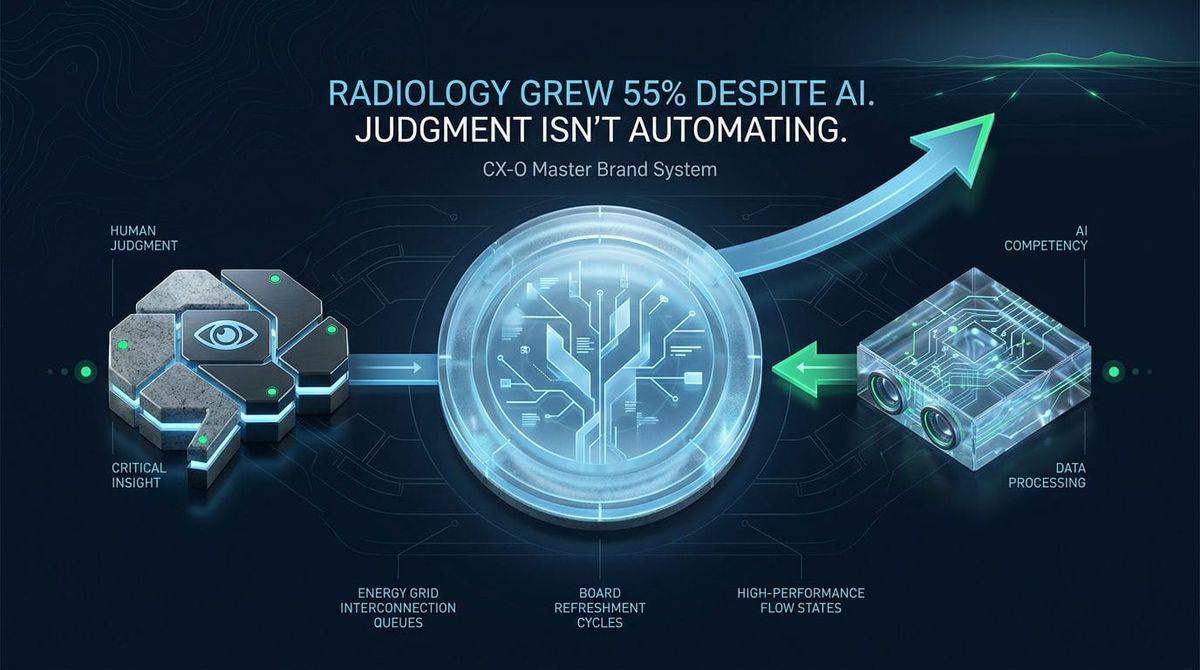
The premium on human judgment and emotional resonance has never been higher as AI commoditizes technical competency and content production.
📊 10 episodes across 9 podcasts
⏱ 6 hours 18 minutes of intelligence analyzed
🎙 Featuring: Oliver Aust, Dr. Christian Poensgen, Natalie Runyon, Dr. Gleb Tsipursky, Scott Galloway, Adam Grant, Josh Tyrangiel, Joe Preston, Astro Teller, David Zwillinger, James D. White, Bouchra Danwra
|
The Human Edge in the Era of Infinite Content
As generative AI floods the market with "average" competency, the strategic delta for leaders has shifted from technical oversight to storytelling and psychological management. We are moving from an era of execution to an era of curation and resonance.
The Identity Crisis: Dr. Gleb Tsipursky notes that AI is the first technology to challenge our core identity—human intelligence. This creates a psychological barrier that technical training cannot solve. Meanwhile, Scott Galloway observes a major market correction: the "radiology at Mayo Clinic" effect. Despite AI's ability to read scans, radiology headcount grew 55% because the job isn't scanning—it's judgment.
"In a world where AI can produce infinite competent content, what's scarce is a genuine human perspective, a real point of view delivered with craft. That skill is now priced accordingly."
— Scott Galloway, Professor of Marketing at NYU Stern on The Prof G Pod
The Performance Paradox: To compete, humans must optimize their "biological hardware." Dr. Christian Poensgen argues that doubling productivity doesn't require more hours, but rather protecting the "deep work" flow state—which currently averages a dismal 24 minutes per day.
Why it matters: Strategic differentiation no longer comes from what you can build, but from the "voice" and "credibility" you bring to the build. Organizations like OpenAI are acquiring media properties not for ad revenue, but to solve "brand problems" through human-centric storytelling.
Board Question: If AI commoditizes our core technical output, what is the "human outlier" skill in our leadership team that remains unreplicable?
IDEAS IN BRIEF
① The "Culture Add" vs. "Culture Fit" Trap.
Organizational psychologist Adam Grant argues that hiring for "culture fit" after the startup phase leads to stagnation and groupthink. (Adam Grant on HBR IdeaCast)
→ The Implication: Leaders should pivot to "culture add," specifically seeking "disagreeable givers" who challenge norms to enrich the organization's collective intelligence.
② Renewable Energy’s Shift from ESG to Economics.
Renewable energy adoption is no longer driven by sentiment but by hard cost-efficiency; solar accounted for 54% of all new US generating capacity last year. (David Zwillinger on C-Suite Perspectives)
→ The Signal: The primary bottleneck for the AI-driven power surge is no longer capital or tech, but the 3–7 year grid interconnection queue.
③ 🆕 Sprints and Recovery as a Burnout Antidote.
New Balance has scaled to a $10 billion enterprise by utilizing "Ninja" teams that tackle 90-day sprints followed by mandated recovery periods. (Joe Preston on How Leaders Lead)
→ The Implication: High-growth execution is a marathon of sprints; without structural "recovery" periods, project quality inevitably degrades under the weight of chronic stress.
④ Rewarding Habits Over Outcomes for Innovation.
At Alphabet’s X, rewarding project outcomes is seen as "the death of radical innovation" because it encourages playing it safe. (Astro Teller on Think Fast Talk Smart)
→ The Strategy: Performance management should reward the habits of humility and curiosity, as 99% of "moonshots" are designed to fail quickly during the learning phase.
⑤ Board Refreshment and the Seven-Year Itch.
James D. White suggests that director independence and relevance begin to fade after a 7-to-9-year tenure, especially as AI renders old skill sets obsolete. (James D. White on Boardroom Governance)
→ The Implication: Boards must develop "off-boarding" cultures to replace stagnant directors with those who understand current technological disruptions.
SIGNAL BOARD
🔥 HEATING UP
• Deep Work Flow State: Increasing focus from 24 to 90 minutes daily is the new productivity frontier. (Dr. Christian Poensgen on Speak Like a CEO)
• Storytelling in Tech: Human perspective is now a high-premium "outlier" skill in an AI-saturated market. (Scott Galloway on The Prof G Pod)
👁️ ON WATCH
• 🆕 Data Centers in Space: Major tech players are exploring orbital compute to bypass terrestrial constraints within 5-7 years. (Josh Tyrangiel on The Prof G Pod)
• 🆕 Digital Twins of the Grid: Comprehensive mapping is the prerequisite for AI-optimized energy management. (Astro Teller on Think Fast Talk Smart)
❄️ COOLING OFF
• Politeness Cultures: Organizations that value "niceness" over direct feedback are losing the ability to innovate. (Adam Grant on HBR IdeaCast)
• AI Usage Metrics: Measuring how much AI is used rather than business outcomes leads to "workslop." (Dr. Gleb Tsipursky on Clarity)
THE TENSION
The debate centers on whether the privatization of critical infrastructure is a triumph of efficiency or a catastrophic national security risk.
🔵 Perspective One: The shift of space exploration to commercial partners like SpaceX has decimated costs and accelerated innovation. This model allows the government to be a customer rather than a bloated operator, leveraging "pirate ship" execution to maintain global dominance.
🔴 Perspective Two: The concentration of power in a single private citizen—specifically Elon Musk’s control over Starlink—creates a "private citizen monopoly" that the US government cannot control, even when national security is at stake in active conflict zones.
The Strategist's Read: While the efficiency gains are undeniable (SpaceX's 600 boosters vs. Blue Origin's 3), the lack of a "Plan B" makes the US government a hostage to private whims. Expect a regulatory push for "enforced competition" to ensure the state is never beholden to a single provider.
THE BOTTOM LINE
In an age of infinite automated output, the most valuable asset is the human judgment required to tell the machine what is worth making.
APPENDIX
Boardroom Governance: "James D. White: What Makes Boards Work" · 40 min · Featuring James D. White ▶ Listen · Apple Podcasts
For the Strategic Board: Critical for understanding board refreshment and the CEO-Chair relationship during tech shifts.
C-Suite Perspectives: "How Solar and Battery Storage Can Meet Rising US Power Demand" · 23 min · Featuring David Zwillinger ▶ Listen · Apple Podcasts
For the Energy-Conscious Executive: Explains why the transition to renewables is now an economic play, not an ESG one.
Clarity: "How does the human side of AI transformation make or break an enterprise AI strategy?" · 44 min · Featuring Dr. Gleb Tsipursky ▶ Listen · Apple Podcasts
For the Transformation Leader: A deep dive into the psychological resistance profiles that stall AI ROI.
HBR IdeaCast: "Why Great Teams Don't Need to Like Each Other" · 32 min · Featuring Adam Grant ▶ Listen · Apple Podcasts
For the People Strategy Officer: Challenges the "culture fit" narrative in favor of task-aligned "culture add."
How Leaders Lead: "Joe Preston, President & CEO, New Balance – Focus on what you can control" · 64 min · Featuring Joe Preston ▶ Listen · Apple Podcasts
For the Growth CEO: A masterclass in scaling a legacy brand to $10B through internal focus and "sprint" cultures.
Speak Like a CEO: "The 3 Secrets to Ultraproductive Communication" · 37 min · Featuring Dr. Christian Poensgen ▶ Listen · Apple Podcasts
For the High-Performance Leader: Tactical advice on optimizing biological rhythms and communication to avoid burnout.
The Leadership Podcast: "TLP533: What CEOs and Young Graduates Can Teach Each Other" · 38 min · Featuring Bouchra Danwra ▶ Listen · Apple Podcasts
For the Mentorship-Minded: Explores how bridging the generational gap fosters creativity and reduces the "victim mentality."
The Prof G Pod: "Why Storytelling Is Now the Most Valuable Skill in Tech" · 17 min · Featuring Scott Galloway ▶ Listen · Apple Podcasts
For the Career Strategist: Argues why emotional resonance is the only hedge against AI commoditization.
The Prof G Pod: "Musk vs. Bezos: The Battle to Control Space" · 48 min · Featuring Josh Tyrangiel ▶ Listen · Apple Podcasts
For the Macro Analyst: Analyzes the geopolitical and national security implications of the private space race.
Think Fast Talk Smart: "332. Rethinks: Learn Faster and Fail Smarter" · 35 min · Featuring Astro Teller ▶ Listen · Apple Podcasts
For the Innovation Head: Explains the "moonshot" philosophy of rewarding learning habits over project success.
Topics