PodStreet Weekly
 Velocity Meter
 CX-O
CX-O Cult of Brands
 Growth Glider
 Dear Brain
Vulcan Materials Says 'Data First', AI Follows
AI discussions now focus on how it fundamentally changes operations, exposing messy data and siloed systems as operational debt.
The Shift to AI-Enabled Human Enhancement
This week, the hard reality sets in: AI isn't just automating tasks; it's redesigning the foundational elements of product-market fit, pricing models, and even how we identify and value our most indispensable talent.
📊 12 episodes across 10 podcasts
⏱ 454 minutes of intelligence analyzed
🎙 Featuring: David McClelland, Roy Hefer, Scott W. Luton, Karin Bursa
|
The Big Shift
The conversation around AI has matured beyond "what can it do?" to "what does it fundamentally change about how we operate?" We're seeing a critical shift from AI as a productivity tool to AI as a catalyst for completely reimagining organizational structures, talent deployment, and even the core value proposition of products. The era of simply throwing AI at existing problems is yielding to a mandate to redesign entire enterprise workflows.
Why it matters: The biggest lever isn't always the newest tech. It's often the hardest, most unglamorous work of simplifying systems, cleaning master data, and rethinking processes from the ground up. Krzysztof Soltan, CIO of Vulcan Materials, underscores this, stating that "everywhere I turn around, I talk about data first... less systems, less to maintain, less to integrate, less to train, will result in more value." This isn't just about efficiency; it's about building a robust foundation for scaling truly impactful AI, not just chasing shiny objects.
The Operator's Take: The 'aha!' moment for many isn't the AI itself, but realizing that AI exposes the structural weaknesses you've been tolerating. Messy master data, siloed systems, and processes — these become glaring choke points when you try to integrate advanced AI. You can't just slap a large language model on a broken process and expect orders-of-magnitude improvement. As Wiley Jones, Co-founder and CEO of DOSS, bluntly put it, "The things that organizations come to you and they ask you to help them solve are not the problems they actually have... Actually you just have very, very messy master data. And your item master needs to be completely rebuilt." The signal is clear: AI isn't just augmenting operations; it's forcing a long-overdue reckoning with operational debt.
"My team will tell you, everywhere I turn around, I talk about data first. Because, you know, we always, we've heard this saying many times, less is more and, you know, less systems, less to maintain, less to integrate, less to train, will result in more value."
— Krzysztof Soltan, Chief Information Officer of Vulcan Materials Company on Technovation with Peter High (CIO, CTO, CDO, CXO Interviews)
The Path Forward: This isn't a tech problem; it's a leadership problem. Karin Bursa, Host of Supply Chain Now, observed that "Leadership is responsible for developing a culture and deciding what that culture is going to be... All too often we have more leadership problems than we have technology problems." The real work involves clarity of vision, empowering teams, and having the courage to abandon "best practices" that no longer apply. It means redesigning for AI, not just patching with it.
The Rundown
① AI-Driven Margin Expansion Isn't Hype, It's Happening.
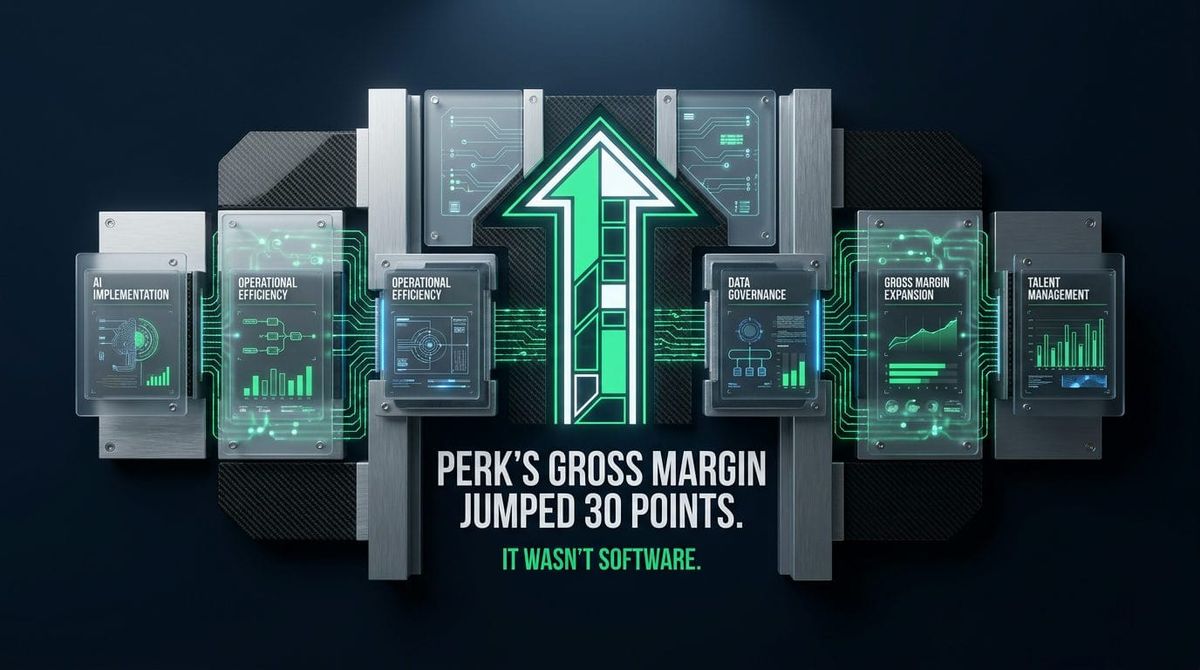
Perk's CFO, Roy Hefer, shared how early and aggressive AI adoption in customer care operations propelled their gross margins from sub-40% to mid-70s. (Roy Hefer on The CFO Playbook)
→ The Operator's Take: This isn't a theoretical use case. This is a direct financial impact on the P&L, demonstrating AI's power to fundamentally reshape unit economics beyond simple cost cutting.
② Specialist Talent Is Gold – Don't Promote Them Out of Their Value.
Jack McCullough's concept of 'Rodmans' highlights irreplaceable specialists who are often more valuable than C-suite execs but thrive in non-managerial roles; promoting them into management is often "the worst thing you can do for them (and for the business)." (Jack McCullough on CFO 4.0 - The Future of Finance)
→ The Operator's Take: Implement dual career paths that reward technical mastery and specialized expertise, protecting these critical contributors from bureaucratic drag and valuing their "digging" over "climbing" the traditional ladder.
③ AI's Physical Footprint Is Reshaping Freight Economics.
The Q2 2026 U.S. Bank Freight Payment Index reveals a "bifurcation" where AI infrastructure build-out (servers, GPUs, cooling systems) is driving unprecedented air freight volumes and price spikes, even as national freight demand remains subdued. (Bobby Holland & Jason Miller on Supply Chain Now)
→ The Operator's Take: Don't look at "national" freight trends; understand the highly segmented demand. If your business relies on high-tech components, factor in extreme inflationary pressure on logistics and material costs—memory chips are up 849% YOY, data center build costs are doubling.
④ The "Demo vs. Product" Gap in AI is Wider Than You Think.
Chris Churchman, Head of Marquee at Goldman Sachs, emphasized that a demo showcases an AI's best day, while a product is judged on its worst. The hard work of reliability and auditable grounding frameworks is "boring, hard, actually pretty thankless work." (Chris Churchman on Exchanges)
→ The Operator's Take: Prioritize robust grounding frameworks and firm-specific proprietary data. Don't build around temporary model deficiencies; instead, focus on systems that enhance human reasoning, rather than attempting to replace it entirely with flawed automation.
⑤ CFOs Are Forging Unconventional Paths to the Top.
Becky Glover became a CFO without a university degree, leveraging AAT/ACCA qualifications and diverse practical experience, including running her own e-commerce business. (Becky Glover on GrowCFO Show)
→ The Operator's Take: Formal education isn't the only, or even best, path to executive leadership anymore. Prioritize entrepreneurial experience and a willingness to "say yes" to varied opportunities to build a robust, practical skillset.
Signal Board
📈 HEATING UP
• AI-Driven Gross Margin Expansion: Perk's CFO Roy Hefer saw gross margins jump from sub 40% to mid-70s by aggressively adopting AI in customer care. (Roy Hefer on The CFO Playbook)
• Specialist Employee Value: Companies are recognizing the irreplaceable value of niche experts (Rodmans) who don't fit traditional leadership molds. (Jack McCullough on CFO 4.0 - The Future of Finance)
• AI's Physical Supply Chain Impact: AI infrastructure buildouts are driving specific freight growth and significant cost increases in components like memory chips and steel. (Jason Miller on Supply Chain Now)
🆕 ON WATCH
• Agentic Commerce / AI Agents in Commerce: Rapid rise in agentic AI in e-commerce, impacting supply chain trust and fraud. (Lora Cecere on Supply Chain Now)
• Leveraging technology for efficiency and 'headspace': Becky Glover noted that AI should create more time for human interaction and deeper work, not just output. (Becky Glover on GrowCFO Show)
• Medicare for All (Cost Analysis): 🆕Mark Cuban's criticism of Yale study's fraud savings assumptions based on outdated data from Taiwan. (Mark Cuban on The Indicator from Planet Money)
📉 COOLING OFF
• Traditional Supply Chain Forecasting: Outdated forecasting methods are failing in complex nonlinear supply chains, leading to worse performance. (Lora Cecere on Supply Chain Now)
• Uncritical AI Adoption ("AI Stupid"): Simply putting agents on top of existing, flawed supply chain planning taxonomies is leading to poor outcomes. (Lora Cecere on Supply Chain Now)
• AI Without Data Readiness: 90% of enterprises are stuck in AI experimentation because they haven't gotten their "basics right," like master data governance and APIs. (Rajesh Ganesan on Digital Transformation Podcast)
The Bottom Line
Stop layering AI on broken processes; instead, use it as the forcing function to finally clean your data, simplify your systems, and redesign for genuine operational excellence.
Quick Appendix
CFO 4.0 - The Future of Finance: "284. Finding your Rodman: The quiet specialists holding your company together with Jack McCullough" · 35 min · Featuring Hannah Munro, Jack McCullough▶ Listen
For Ops Leaders grappling with talent retention: Learn how to identify and retain your most critical, non-managerial specialists, rethinking traditional reward structures.
CFO THOUGHT LEADER: "1208: Quality, Trust, and Scale | Cal Brouilette, CFO, Flatiron Health" · 46 min · Featuring Cal Brouilette, The Future of Finance is Listening▶ Listen · Apple Podcasts
For Finance leaders investing in AI: Understand how to build trust and auditability into AI-generated insights, especially for critical financial decisions.
Digital Transformation Podcast: "Adopting AI for Autonomous Workflows" · 30 min · Featuring Rajesh Ganesan, Kevin Craine▶ Listen · Apple Podcasts
For CIOs and Digital Transformation Leads: Get a reality check on enterprise AI adoption, focusing on the foundational data and governance needed for true autonomy.
Exchanges: "Building AI Systems for Capital Markets" · 27 min · Featuring Chris Churchman, Allison Nathan▶ Listen · Apple Podcasts
For Product and Tech Heads building AI solutions: Hear Goldman Sachs' pragmatic approach to bridging the "demo vs. product" gap in AI, prioritizing reliability and human augmentation.
GrowCFO Show: "#298 How Can You Fast-Track Your Career to CFO? Becky Glover Chief Financial Officer, Mazuma" · 35 min · Featuring Kevin Appleby, Becky Glover▶ Listen · Apple Podcasts
For aspiring CFOs and talent managers: Explore unconventional career paths to executive finance roles, emphasizing diverse experience and entrepreneurial drive over traditional degrees.
Run the Numbers: "How AI Is Rewriting Product-Market Fit, Pricing, and Go-to-Market" · 45 min · Featuring CJ Gustafson, Rebecca Schwartz▶ Listen · Apple Podcasts
For SaaS Founders and Revenue Leaders: Understand how AI is forcing a re-evaluation of pricing models, product-market fit, and go-to-market strategies for AI-native companies.
Supply Chain Now: "Analysis of the Q2 2026 U.S. Bank Freight Payment Index" · 55 min · Featuring Scott W. Luton, Karin Bursa▶ Listen · Apple Podcasts
For Supply Chain and Logistics Executives: Analyze the specific regional and sectoral impacts of AI infrastructure on freight costs and capacity, allowing for nuanced planning.
Supply Chain Now: "The Buzz: Fixing Supply Chain Performance in the AI Era" · 55 min · Featuring Scott Luton, Paul J. Noble▶ Listen · Apple Podcasts
For Supply Chain Strategists: Challenge outdated "best practices" and address the critical issue of exponentially rising AI-driven supply chain fraud.
Supply Chain Now: "Enterprise Unleashed: The Biggest Lessons from 2026 So Far" · 52 min · Featuring Scott W. Luton, Karin Bursa▶ Listen · Apple Podcasts
For all C-suite leaders: Learn how leadership clarity, workflow redesign, and tackling messy master data are paramount for successful AI transformation.
Technovation with Peter High (CIO, CTO, CDO, CXO Interviews): "Simplify First, Scale AI Next with Vulcan Materials CIO Krzysztof Soltan" · 36 min · Featuring Krzysztof Soltan, Peter High▶ Listen · Apple Podcasts
For CIOs and Digital Transformation Architects: Gain insights into building a robust, data-first foundation for strategic AI implementation, especially in traditional industries.
The CFO Playbook: "Leading Finance Through Hypergrowth with Roy Hefer" · 29 min · Featuring David McClelland, Roy Hefer▶ Listen · Apple Podcasts
For Finance leaders in scaling companies: Get actionable strategies for building a world-class finance team and leveraging AI for significant gross margin expansion during hypergrowth.
The Indicator from Planet Money: "What Mark Cuban REALLY thinks of Medicare for All" · 9 min · Featuring Mark Cuban, Ricky Mulvey▶ Listen · Apple Podcasts
For leaders interested in healthcare policy and economic models: Hear a critical, data-driven perspective on assumptions made in large-scale healthcare policy proposals.
Topics