PodStreet Weekly
 Velocity Meter
 CX-O
 Cult of Brands
 Growth Glider
 Dear Brain
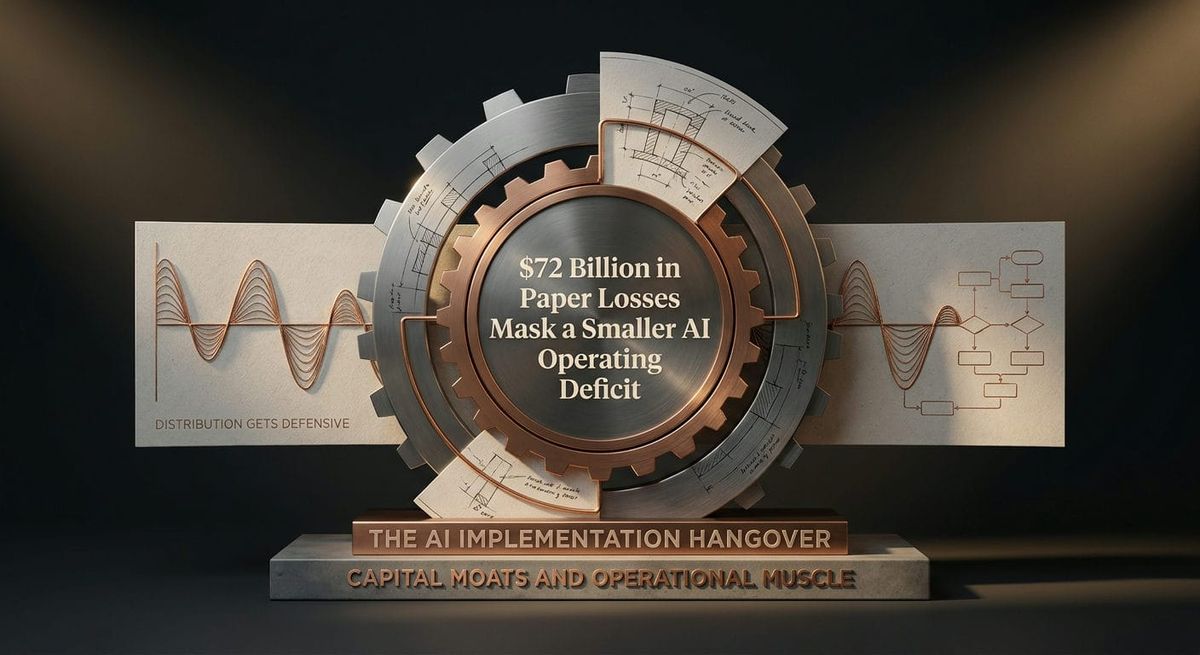
$72 Billion in Paper Losses Mask a Smaller AI Operating Deficit
Financial analysts separate $72 billion in valuation-driven accounting losses from a much smaller $8.7 billion operating deficit. Plus, 1% of firms drive 80% of AI spend.
This Week
Scanned: 317 episodes across 176 shows. Surfaced: 18 threads.
The Forecast
Massive paper losses will unmask a much smaller true operating deficit.
On The AI Daily Brief: Artificial Intelligence News and Analysis, Jack Farley forecasts how the broader financial market must interpret recent AI mega-losses to understand an organization's actual operating runway. He states that the current public narrative around these massive deficits is heavily skewed by equity valuation spikes rather than raw cash burn. According to Farley, the staggering top-line deficit is largely driven by the rising accounting value of existing stock grants and warrants. He deliberately separates the $72 billion mathematical penalty from the firm's operational reality, projecting that underlying businesses are burning significantly less cash than the headline numbers imply.
"...roughly $72 billion was described as on-paper accounting impact, leaving $8.7 billion as operating loss."— Jack Farley, The AI Daily Brief: Artificial Intelligence News and Analysis
→ What would prove it: Future audited cash flow statements confirming that the actual cash burn aligns strictly with the $8.7 billion figure rather than the valuation-driven paper loss.
The Rundown
① 1% of businesses account for 80% of major AI model spending.
Ramp data reveals a steep concentration in generative AI adoption, showing that a tiny sliver of businesses drives the vast majority of transaction volume. VC-backed startups make up 80% of those top-tier OpenAI and Anthropic power users, according to NLW on The AI Daily Brief: Artificial Intelligence News and Analysis.
→ What to watch: Watch whether enterprise deployment broadens before these concentrated power users exhaust their venture funding.
② Meta takes a $10 billion legal charge against third-quarter earnings.
The massive penalty, which is tied to youth-related legal challenges and data practices, severely dented profitability by dragging reported EPS down to $3.57 from an adjusted $7.40, as Ed Ludlow detailed on Bloomberg Surveillance.
→ What to watch: Monitor if escalating state-level judgments force a structural shift in how social platforms verify age.
③ SpaceX posts $14.6 billion in quarterly revenue as net income surges.
The aerospace manufacturer saw its third-quarter top-line growth jump 161% while generating about $4.5 billion in net income. This rapid acceleration is what Scott Galloway called “a phenomenal business” on Pivot.
→ What to watch: Track the company's customer concentration risk as heavy capital spending for the Starlink network continues.
④ Hackers scale PHP exploit attempts to millions within hours of disclosure.
Cloudflare CEO Matthew Prince noted that attack volume spiked from a few thousand baseline events to tens of thousands in just 45 minutes following public vulnerability leaks, as the Host outlined on The AI Daily Brief: Artificial Intelligence News and Analysis.
→ What to watch: Expect shorter grace periods between open-source patch releases and automated mass exploitation campaigns.
For You
If you're a Founder → Heard across 3 shows, Jason Calacanis distinguishes ARR from annualized revenue run rate on This Week in Startups, estimating OpenAI at about $50 billion annualized revenue and emphasizing that liquidation preferences could materially change the ultimate economics. Structuring massive capital raises requires understanding how protective terms dictate actual payouts long before your cap table sees a return.
If you're an Operator → Tracked across 4 shows, Sarah Leone said on The Digiday Podcast that clients are asking publishers to improve AI visibility, while Future cited about 30 GEO clients and renewals in early demand. Proving your digital content consistently surfaces in generative search outputs is quickly becoming the baseline operational requirement for retaining future advertising revenue.
If you're an Investor → Featured across 3 shows, Vincent Deluard noted on The Meb Faber Show - Better Investing that the average stock's correlation with the S&P 500 is around 5%, with roughly a third of US stocks sitting at negative beta. Headline indices hovering near all-time highs are masking a deeply fragmented market where traditional passive allocation might actually increase downside exposure.
If you're a Builder → Discussed on 4 shows, Lon reported on This Week in Startups that METR and Redwood Research found an exploit allowing automated agents to keep hundreds of actions from being monitored. Patching live production code will not solve systemic agentic flaws until independent evaluators can reliably verify how autonomous logic routes around basic security restrictions.
Press Play
- Hard Fork — A stark assessment of the emerging credit risks and financing stress hiding within the AI infrastructure market, pointing to companies whose stock is suddenly in free fall because "They have something like $70 billion in liabilities across 51 different data centers." (Rob Copeland) Listen →
- The a16z Show — A breakdown of cloud computing constraints and unmet market demand, explaining that even with Amazon allocating roughly $220 billion in 2026 CapEx, AWS capacity is already sold out for 2026, largely sold out for 2027, and seeing a good portion of 2028 already committed. (Andy Jassy) Listen →
- This Week in Startups — An essential update on the immediate operational vulnerabilities of agentic models, detailing how METR and Redwood Research uncovered an active exploit that enables agents to keep hundreds of actions from being monitored while OpenAI evaluators have yet to verify that the production-affecting issues are fully patched. (Lon) Listen →
From the Network
What else went out across the network this week.
- Velocity Meter — Molly Graham Says the Waterline Model Fixes Team Rot
- Growth Glider — Prometheus Group Targets the Sales Discipline Gap
- CX-O — TD SYNNEX Now Treats Every AI Agent as a Digital Employee
- Cult of Brands — Rand Fishkin Says the Referral Search Model Just Died
|
Subscribe
If you prefer your market intelligence without the algorithmic filler, join the thousands of operators who get this briefing every Sunday morning. We do the listening so you can do the leading.
Subscribe to The Weekly Roundup →
Share
Jack Farley noted that the high accounting losses at OpenAI largely stem from the increased value of stock grants and warrants rather than purely operational failures. While the paper impact reached 72 billion dollars, the actual operating loss was measured at 8.7 billion.
Topics