PodStreet Weekly
 Velocity Meter
 CX-O
CX-O Cult of Brands
 Growth Glider
 Dear Brain
AI Accelerates Everything, but Humans Still Drive Strategy
AI accelerates tasks, transforming industries, but human insight remains bedrock for high-level strategy, driving competitive advantage and shaping business futures.
Strategy Remains a Human Game
While AI automates tasks and transforms industries, the bedrock of high-level strategy continues to be uniquely human. This week's conversations reveal how deep insight drives competitive advantage.
The Human Element in Data and Decisions
In a world awash with AI-generated data, human intuition and curation are more valuable than ever. Can Simile's Data Strategy Shape the Future for Fortune 500? discusses the shift in AI talent from model building to practical application, highlighting the premium on individuals who can translate AI output into actionable work. Similarly, AlphaSense Does 90% of Research, but Humans Provide Intuition explores how AI can handle 90% of the research load, but the remaining 10%—the intuitive leap, the strategic insight—is exclusively human. This efficiency arms race demands a re-architecture of business processes, not just the introduction of new tools.
Marketing's Strategic Evolution
The role of marketing has broadened significantly. No longer confined to brand and demand, CMOs are now integral to enterprise-level strategy, influencing product development, finance, and organizational design. Marketing Was a Cost Center, but Now It Reshapes the Business emphasizes this shift, painting CMOs as true enterprise strategists. The convergence of brand and performance, coupled with the strategic integration of AI, underscores this new mandate. However, the industry faces challenges, as 80 Percent of Agencies Will Struggle as AI Redefines Value suggests, with AI shifting power dynamics and pushing many agencies towards obsolescence without significant upskilling and strategic adaptation.
Global Strategy and Human Connection
Geopolitical maneuvering in the AI space demonstrates the continued importance of human-led strategy on a global scale. How Does China Build Global Digital Leadership Through Open Source AI? examines China's strategic push for open-source AI dominance, a move driven by complex national interests and leadership decisions. Meanwhile, the B2B sales landscape is also undergoing a human-centric transformation. 15 Years Behind Western B2B, Japan Offers a New Empathic Perspective points to a new B2B sales playbook that prioritizes empathy over transactions, especially as AI accelerates buyer behaviors. This strategic precision, built on human understanding, becomes paramount.
The Enduring Power of Human Intellect
Despite AI's rapid advancements, human intellect remains the ultimate differentiator. Bill Thompson Says Human Intel Beats Tech 95% of the Time captures this sentiment, arguing that competitive advantage often stems from unconventional human intelligence, even in an AI-dominated world. This highlights that while AI can process and predict, the truly insightful, disruptive, and empathetic strategies still originate from human minds.
A Note from Chris
I kept coming back to a warning from Eddie Ra this week: AI cannot fix broken processes. For a year, the talk was all about what AI could do. Now, the conversation is about what it’s exposing. Suddenly, it feels like every team is looking in the mirror and realizing the new tech won't work without fixing the old wiring. The magic show is over, and the renovation has begun. It’s less glamorous, but it’s where the real value is being created.
Here’s what was worth listening to.
— Chris
|
The Through-Line
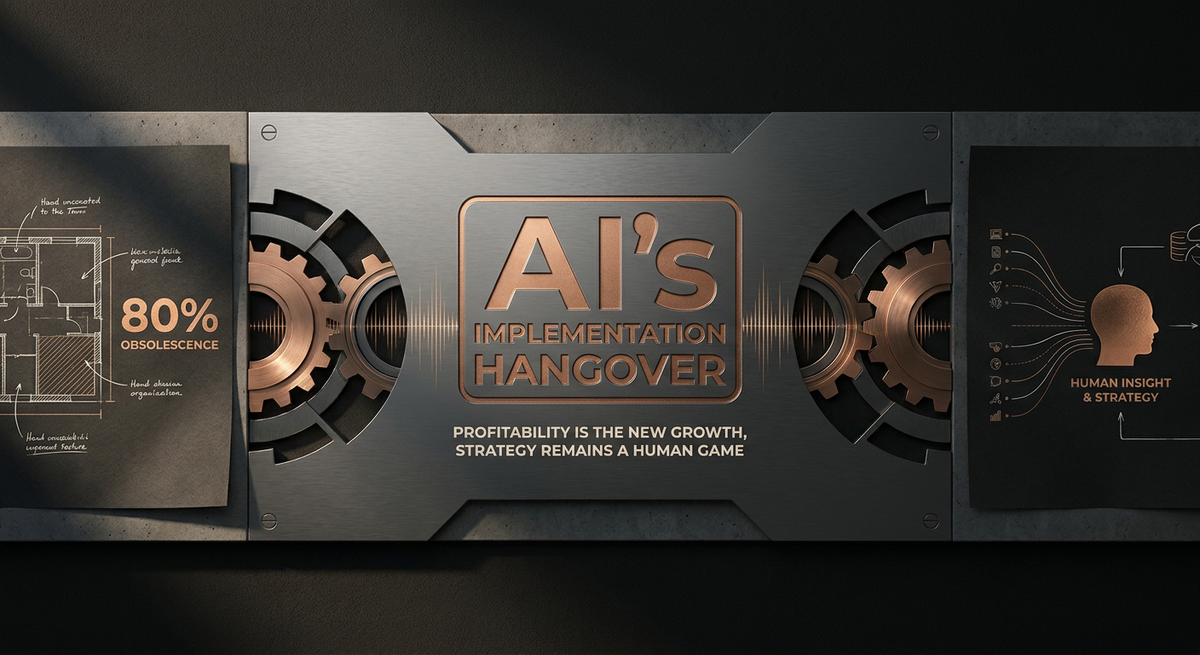
AI’s Implementation Hangover
The initial thrill of generative AI has given way to a sober accounting of its real-world impact. Across Podstreet, the dominant conversation shifted from what’s possible to what’s practical, exposing broken processes and forcing a reckoning in roles from product management to marketing.
The consequences are already rippling through the service layer. A stark analysis in Cult of Brands warned that as AI automates execution, up to 80 percent of marketing agencies face a struggle for survival. The value proposition is being fundamentally rewritten, and firms that can't move from task-doers to strategic partners will be left behind.
This pressure is just as intense inside company walls. In a conversation on Lenny's Podcast: Product | Career | Growth, highlighted in Growth Glider, Whatnot CPO Tom Verrilli went so far as to question the future of the product management function itself. As AI empowers engineers with direct customer insight and data analysis, the traditional role of the PM as an intermediary is eroding. This isn't just about adopting new tools; it's a ground-up rewiring of how teams build.
The finance department is experiencing a similar upheaval. As covered by CX-O, AlphaSense CFO Samantha Greenberg explained on CFO THOUGHT LEADER that while AI can perform 90 percent of the research, the final 10 percent relies on human intuition. This creates a new mandate for finance professionals: master the technology to free up capacity for higher-order strategic judgment.
Ultimately, these are not stories about technology failing. They are stories about technology succeeding so profoundly that it acts as an unforgiving audit on the business itself. The essential warning, summarized by Growth Glider, came from RevOps expert Eddie Ra.
AI cannot fix broken processes.—Eddie Ra, as highlighted in Growth Glider
This is the core of the implementation hangover. The time for isolated pilots is over. AI is no longer a magic wand to wave at inefficiency, but a mirror reflecting every crack in a company’s foundation.
The conversations ahead won't be about which model to use. They will be about who has the operational discipline to rebuild their workflows, retrain their people, and turn the painful process of implementation into a durable competitive advantage.
Heard in Three Rooms
As tools get smarter, the ultimate advantage remains stubbornly human. The theme that strategy is a game of insight, not automation, echoed in three very different rooms last week, surfacing on Cult of Brands, CX-O, and Growth Glider at the same time.
- In the Brand Strategy Brief from Cult of Brands, the focus was on the CMO’s expanding role as an enterprise-level strategist, a shift explored on Renegade Marketers Unite as marketing’s influence now reshapes the entire business.
- The CEO & Leadership Brief on CX-O looked at strategy through a geopolitical lens, analyzing China’s high-stakes push for global leadership through open-source AI.
- And Growth Glider’s B2B Sales Brief found its strategic edge in empathy, with Sales Pipeline Radio arguing that Japan’s bottom-up, relationship-driven sales culture offers a powerful playbook for the West.
When conversations about brand, geopolitics, and B2B sales all independently land on human intuition as the key differentiator, it’s a clear signal that the most durable advantages can’t be downloaded.
The Tracker
Since this is the first week on record, we're establishing a baseline for the signals that dominated the conversation. Here’s what’s building momentum.
AI's Implementation Hangover
- On the radar: 1 week (Quietly building)
- The read: The next phase of AI is less about magic and more about fixing the messy operational details and broken workflows it exposes.
- Heard from: Tom Verrilli, CPO of Whatnot, questioning the very existence of the product management role on Lenny's Podcast: Product | Career | Growth.
Profitability Is the New Growth
- On the radar: 1 week (Quietly building)
- The read: Investors are finished funding growth at all costs, signaling a market-wide return to fundamentals and a demand for sustainable margins.
- Heard from: Jim Bianco on Macro Voices, exploring whether the market—not the Fed—will ultimately solve inflation.
|
Press Play
A few conversations that cut through the noise this week.
Revenue Builders
Where AI Is Actually Working in Revenue Teams with Alex BilmesFor sales and RevOps teams tired of the hype, this episode offers clear examples of where AI creates real leverage in the GTM motion today.
CFO THOUGHT LEADER
1202: Allocating Capital in an Age of AI | Samantha Greenberg, CFO, AlphaSenseFor finance leaders who need a practical framework for investing in AI while keeping a firm grip on the bottom line and human intuition.
Lenny's Podcast: Product | Career | Growth
This CPO regrets that product management exists | Tom Verrilli (CPO of Whatnot)Listen to this for a provocative take on how AI is forcing product management to evolve or die, delivered by a CPO in the thick of it.
For You
If you're a Founder → Look to baby apparel brand Magnetic Me for a lesson in sustainable growth, paying its own way since 2012 without venture capital. Their story, detailed on Shopify Masters, is a playbook for building a durable DTC business on profitability and customer loyalty, not cheap capital.
If you're an Operator → Before you invest in another AI tool, heed the warning that technology cannot fix broken internal processes. Across RevOps and finance, the urgent conversation on shows like The B2B Revenue Executive Experience is about fixing the fundamentals first, as AI only accelerates what’s already working—or failing.
If you're an Investor → The market is rewarding fundamentals, and private equity is leading the charge. Adam Crandall’s new benchmark for a win—a “5 to 10 percent margin beat”—signals that the era of valuing revenue growth above all is over, as outlined in the PE Brief.
If you're a Builder → Your role is changing faster than your title, as Whatnot’s CPO Tom Verrilli argued on Lenny's Podcast. His take that AI is empowering engineers to own more of the product lifecycle forces a re-evaluation of the traditional handoff from product to engineering.
The Rewind
This week's most compelling episodes, curated to bring you up to speed.
- The a16z Show:How Enterprise AI Really Gets Deployed. Listen →
- Renegade Marketers Unite: What the 2026 CMO Survey reveals about marketing under pressure. Listen →
- Sales Pipeline Radio:Why top-down sales pitches fall flat in Japan. Listen →
Curious about which trends are shaping the future? Our full roundup offers deeper insights into the stories and shifts that matter most to leaders.
Subscribe to The Weekly Roundup →
AI exposes broken processes and redefines roles, but strategy remains a uniquely human game.
Forward to a friend → · Share on X
📖 Want the full episode breakdowns, guest details, and listen links?
Topics