PodStreet Weekly
 Velocity Meter
 CX-O
CX-O Cult of Brands
 Growth Glider
 Dear Brain
OpenAI Spends $3 to Make $1
The era of unchecked spending on AI infrastructure is meeting resistance. The question is no longer if a company is using AI.
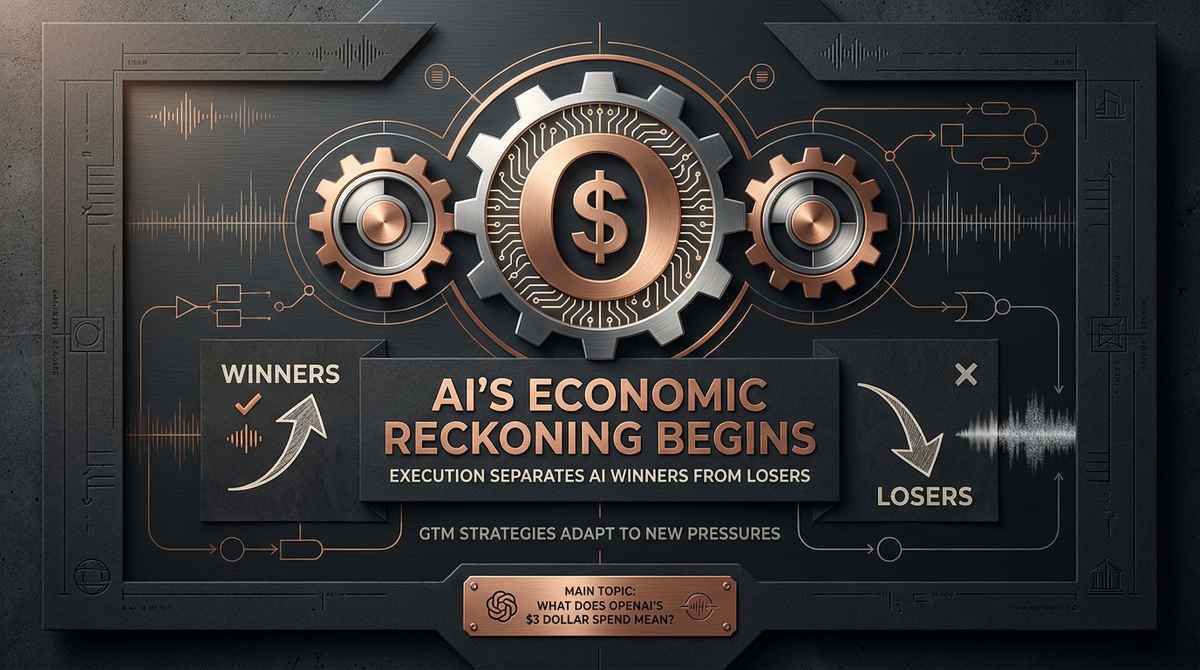
AI's Economic Reckoning Begins
The era of unchecked spending on AI infrastructure is meeting resistance. Conversations last week centered on the massive gap between capital expenditure and revenue, the physical constraints of compute, and a renewed investor focus on free cash flow. The question is no longer if a company is using AI, but whether the unit economics make sense.
- Does OpenAI's $3 Spend per Dollar Signal a Dot-Com Bubble? from CX-O discusses how "The AI narrative is bifurcating: hype-driven venture capital versus tangible user-side value and geopolitical strategy." Listen to Delta's Ed Bastian on spiking fuel, summer travel, and a blunt reality check on AI on Masters of Scale.
- In "10x Token Cost Drop, 100x AI Usage Drives Enterprise Value," Velocity Meter explains how "The AI market is bifurcating: a battle rages for foundational model supremacy, but the immediate, actionable value is in specialized AI." The Twenty Minute VC explores whether OpenAI and Anthropic are overvalued and the reality of open-source AI.
- Velocity Meter also published "The Market Lost Its Tolerance for Company Spending," noting that "The market's narrative is unraveling as persistent inflation and energy tightness clash with AI's promised productivity." Listen to CNBC's "Fast Money" on the AI race to supremacy.
- From Growth Glider, "$688 Billion in AI CAPEX Dwarfs $110 Billion in Revenue" highlights how "The AI investment boom has far outpaced immediate returns, setting up a volatile, but potentially transformative future for software and GTM strategies."
- "601 Minutes of Intelligence Analyzed Fuels Agentic Awakening" from Velocity Meter observed that "The intensifying AI arms race is forcing a fundamental re-evaluation of how businesses manage their most critical assets: data and compute." Hear more about this on Decoder with Nilay Patel where even Nvidia's head of automotive discusses fighting for compute.
A Note from Chris
The story that stuck with me this week wasn’t about a massive funding round, but a factory floor. Hearing that Ford had to rehire hundreds of engineers after an AI deployment went wrong says everything about where we are right now. The initial gold rush is giving way to a hard economic reality check.
The conversation is shifting from what’s possible to what’s profitable and, more importantly, what actually works. It’s a focus on operational grit over unbound hype. You’ll hear that pivot in nearly every conversation we curated for this week’s guide.
— Chris
|
The Through-Line
The quiet part is getting loud: the era of unchecked spending on AI is ending. Across the Podstreet network, the dominant conversation this week was not the unbound potential of artificial intelligence, but the harsh reality of its economic reckoning. Investors are swapping hype for calculators, and for many, the math isn't adding up.
On Growth Glider, the scale of this imbalance was laid bare. A staggering $688 billion in AI-related capital expenditure now dwarfs a mere $110 billion in revenue. This isn't a future projection; it's a current-state crisis of fundamentals. This pressure is felt inside the disruptors themselves, with leaders like Netflix CPTO Elizabeth Stone wrestling with the future of product roles on Lenny's Podcast as companies are forced to justify every dollar.
The view from the C-suite, captured on CX-O, was even more stark. The question of whether OpenAI’s reported $3 spend for every dollar of revenue signals a dot-com style bubble was a recurring theme. The sentiment was amplified by Delta’s CEO Ed Bastian on Masters of Scale, who delivered what the show called a "blunt reality check on AI." This is not a cyclical downturn; it is a structural re-evaluation of value.
The situation recalls a caution that surfaced in a different context this week, but which applies with chilling accuracy to the AI gold rush, where the promised solution has obscured a fundamental risk.
The deepest risks often hide in plain sight or masquerade as solutions.
— Shaunie, former CEO of Opendoor
That risk isn't just financial, it's physical. As Velocity Meter pointed out, the arms race for AI supremacy is creating real-world bottlenecks. On Decoder with Nilay Patel, we learned that even Nvidia's own head of automotive is fighting for GPU access. When the company making the chips can't get enough for its own projects, the entire ecosystem is on notice. The full breakdown from CX-O digs into how this bifurcates the market between the hype and the on-the-ground reality.
This economic pressure is forcing a new conversation. The question is no longer if a company is using AI, but how it will pay for it, and what the tangible return is. The hunt is now on for the new metrics and models that can answer those questions before the market's patience runs out.
Heard in Three Rooms
The real barrier to AI value isn't the technology itself, but the operational challenge of implementing it. This idea surfaced across very different rooms this week, connecting the C-suite conversations on CX-O with the growth-stage analysis inside Velocity Meter. The echo between them is the signal.
In its Strategy & Governance Brief, CX-O highlighted Ford’s struggle, which involved rehiring 350 engineers after AI integration caused new errors—a story detailed on This Week in Business. In parallel, Velocity Meter’s PE Brief noted that legacy legal firms are losing ground not from a lack of data, but a failure to adapt their operating models. The same publication drove the point home in its Critical Thinkers digest, citing a warning from Shaunie, former CEO of Opendoor: “The deepest risks often hide in plain sight or masquerade as solutions.”
When enterprise leaders and private equity strategists independently arrive at the same chokepoint, it confirms the AI race will be won by operators, not just early adopters.
The Tracker
AI's Economic Reckoning
Heating up (1 week on the radar). The era of blank-check AI spending is ending. Leaders must now justify massive capital expenditures with a clear path to free cash flow, shifting the conversation from technological possibility to economic reality. The subject was front and center on The Twenty Minute VC, where Fireworks CEO Lin Qiao explored how a focus on enterprise value, not just foundational model hype, is becoming paramount.
Execution Separates Winners from Losers
Quietly building (1 week on the radar). Access to AI is becoming table stakes. Competitive advantage now comes from operationalizing the technology, which is proving to be a challenge of people and process, not simply tools. OneStream Interim CFO John Kinzer underlined this on CFO THOUGHT LEADER, arguing that the true test isn't AI itself, but leading teams effectively through the change it demands.
The full tracker — every theme, eight weeks back — lives in PodStreet Pro.
Press Play
A few standout conversations that cut through the noise this week, connecting the big picture to what you need to do next.
The Twenty Minute VC (20VC): Venture Capital | Startup Funding | The Pitch
20VC: Are OpenAI and Anthropic Overvalued? The Open-Source AI Reality | How Token Costs Will Fall 10x And Usage Will Explode 100x | The Future Is Not One AGI; It's Millions of Specialised Models with Lin Qiao, Founder and CEO @ Fireworks
This episode goes straight to the heart of the AI economic reckoning, directly questioning the valuation of foundational models. For founders, VCs, and strategists trying to separate hype from reality, it's an essential listen on the unit economics of AI and why the future may belong to millions of specialized models, not one AGI.
Lenny's Podcast: Product | Career | Growth
Netflix CPTO on AI and the future of product and tech roles | Elizabeth Stone
For product leaders and tech executives, this conversation with Netflix's CPTO grounds the abstract potential of AI in the concrete reality of organizational design and product development. It’s a pragmatic look at how AI reshapes teams and roadmaps, delivered from a company that mastered personalization long before the current hype cycle.
This Week in Business
Why Companies Are Rethinking the Rush to Implement AI
Providing a crucial counter-narrative, this is for any operator on the hook for making AI actually work. It uses cautionary tales like Ford's recent rehiring of engineers to illustrate a key theme this week: successful AI implementation is an operational and cultural challenge, not just a technological one.
For You
If you're a Founder → Your path to funding no longer runs through unbound AI hype; investors are demanding a clear line to free cash flow. The real opportunity isn't competing on foundational models but in specialized AI that leverages proprietary data, a point made on The Twenty Minute VC where Fireworks CEO Lin Qiao argued the future is millions of small, expert models.
If you're an Operator → The story of Ford rehiring 350 engineers after AI implementation failures is a clear warning that technology alone solves nothing. As a CX-O brief noted, McKinsey data shows fewer than 100 firms capture two-thirds of all value from AI because they have mastered the operational challenge of execution, not just acquisition.
If you're an Investor → Your due diligence must now brutally prioritize the path to profitability, as the market's tolerance for high spending evaporates. A Growth Glider analysis illustrates the economic reckoning, revealing that $688 billion in industry-wide AI CAPEX is generating only $110 billion in revenue.
If you're a Builder → Your content strategy must expand beyond Google, as AI search creates entirely new discovery channels. A striking Cult of Brands study found that 60% of citations in AI answers never appear in the top 20 traditional search results, making "Answer Engine Optimization" a critical new practice.
The Rewind
The skimmer's index — for the reader who only reads the bottom. A clean list of the episodes referenced this week.
- • CX-O — Delta's Ed Bastian: A blunt reality check on the current state of AI implementation. Listen →
- • Velocity Meter — Lin Qiao: The future is millions of specialized AI models, not a single AGI. Listen →
- • Cult of Brands — Pedro Pina: How YouTube built the creator economy, and what brands are missing. Listen →
- • Growth Glider — Bryan Seiser: Multi-threaded selling and building the closing strategy early drives revenue growth. Listen →
- • Velocity Meter — CNBC's Fast Money: Markets are losing their tolerance for company spending amidst AI race. Listen →
- • Cult of Brands — Marketing Against The Grain: If you use AI for work, you need a second brain. Listen →
- • Growth Glider — Elizabeth Stone: Netflix CPTO on AI and the future of product and tech roles. Listen →
|
Subscribe
In a world of information overload, your time is your most valuable asset. The Podstreet Weekly Roundup cuts through the noise, delivering curated insights directly to your inbox. Stay ahead, effortlessly.
Subscribe to The Weekly Roundup →
Share
The deepest risks often hide in plain sight or masquerade as solutions.
Forward to a friend → · Share on X
📖 Want the full episode breakdowns, guest details, and listen links?
Topics