PodStreet Weekly
 Velocity Meter
 CX-O
CX-O Cult of Brands
 Growth Glider
 Dear Brain
Tines Co-Founder Says AI's Wild Code Needs a Paved Path
Organizations face a critical challenge: govern AI to create 'paved paths' for secure innovation or risk a shadow IT explosion. The initial impulse to restrict access is insufficient.
The age of "wild code" is here, and operators are scrambling to build the guardrails, not just for AI, but for the entire organization.
📊 12 episodes across 11 podcasts
⏱ 493 minutes of intelligence analyzed
🎙 Featuring: Thomas Kinsella, Dan Wells, Kim Jones, Aydin Senkut, Rohini Jain, Ajay Waghray, Aaron Bracci, Rebecca Kehoe, Jan Hatzius, Donald Kohn, Stephen Miran, Martin Uhrik, Nicola Horton, Matt Hedberg, Montez Fitzpatrick, Jonathan Waldrop
|
The Big Shift
The proliferation of "wild code" – ungoverned, unknown agents, automations, and scripts — driven by accessible AI tools, is forcing a fundamental re-evaluation of how organizations manage their digital infrastructure and internal operations. This isn't just about security anymore; it's about control, efficiency, and scale. CIOs and COOs are facing a direct challenge: either build 'paved paths' for governed AI use or contend with a shadow IT epidemic that can cripple productivity and introduce significant risk.
Why it matters: The initial reaction for most leadership teams is to restrict access. However, as Thomas Kinsella, Co-founder and COO of Tines, points out, that approach is bound to fail.
"What you don't want to do is... go down the restrict access completely approach... There has to be that like governed... 'paved path' approach that a lot of engineering teams take."
— Thomas Kinsella, Co-founder and COO of Tines on Technovation with Peter High (CIO, CTO, CDO, CXO Interviews)
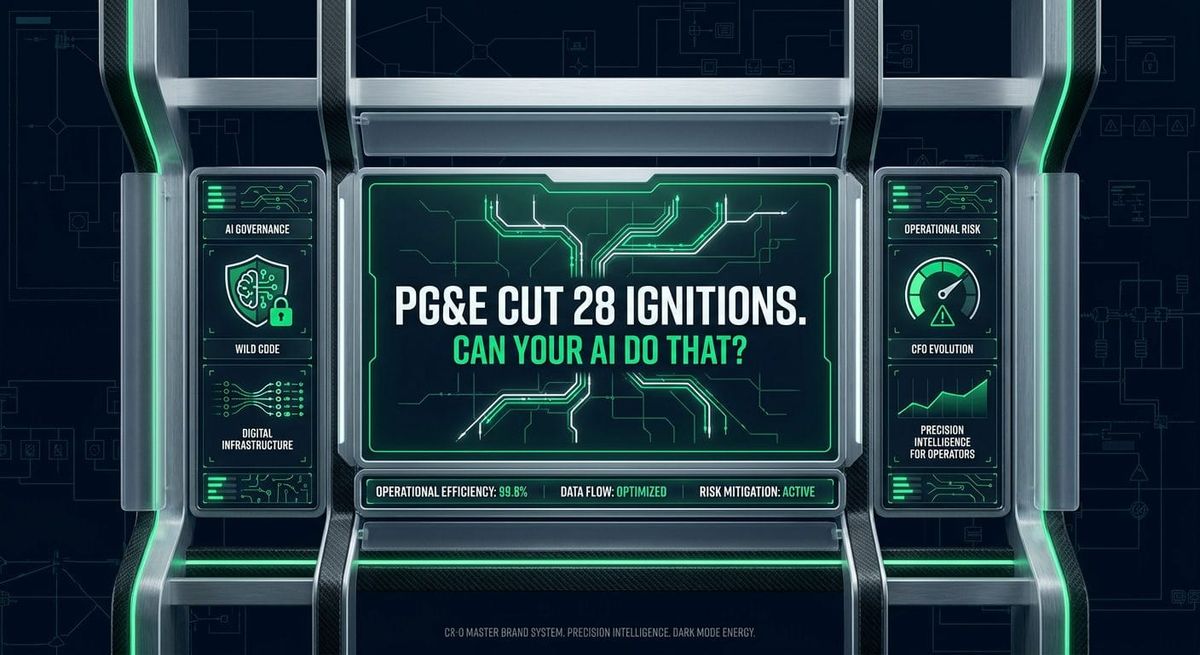
This isn't an AI problem; it's a governance problem amplified by AI. Organizations need to design systems where the secure, compliant path is also the easiest and most attractive for builders. This means proactively creating frameworks and tools that enable teams to experiment and innovate with AI, while embedding visibility, security, and control from the outset. The cost of not doing so is exponentially higher than the investment in these "paved paths." Consider PG&E, which uses AI-powered cameras to prevent 28 ignitions and avoid 19 million outage minutes, but only after building a foundational layer of trusted data. Without that, the AI is just noise.
The Operator's Move: Prioritize defining and implementing 'paved paths' for AI adoption across critical business functions. This includes pre-approved data sources, secure development environments, and automated deployment pipelines that streamline innovation while maintaining governance. Don't restrict; enable with guardrails.
The Rundown
① M&A Integration Requires Leadership Enablement, Not Just Cultural Fit.
Many M&A integration failures are misdiagnosed as culture clashes when they're actually a failure to equip leaders with the clarity and support needed to navigate change. Kim Jones, HR Director of M&A, notes that "Integration problems are a leadership enablement problem, not a culture problem" on M&A Science.
→ The Operator's Take: Invest in pre-close strategic conversations and defined playbooks for integrating leadership teams, especially for smaller acqui-hires where changes are more drastic. Equipping leaders prevents "integration debt."
② Job Hoppers Adapt Faster, Develop Critical Soft Skills.
Research suggests frequent job changes build adaptability and strong soft skills in navigating new cultures, leading to faster performance recovery in new roles, challenging the traditional employer skepticism around job hoppers. Rebecca Kehoe, Professor at Cornell University, found that "Hedge fund managers who had moved more frequently experienced a smaller drop in performance when they changed firms, and they recovered to their prior performance levels more quickly" on The Indicator from Planet Money.
→ The Operator's Take: Re-evaluate hiring biases against job hoppers; these individuals often bring a broader perspective and adaptability critical for rapidly changing environments. Focus interviews on how they leveraged past experiences to quickly deliver impact.
③ Bold, Opinionated AI Bets Outperform Optionality.
In the AI era, strategic capital allocation requires making decisive, "opinionated" bets rather than trying to preserve all options, which often leads to stagnation and missed opportunities. Matt Hedberg, Sell-side Equity Analyst at RBC, argues that "Optionality in AI bets is not free" during his discussion on Run the Numbers.
→ The Operator's Take: Identify 1-2 critical AI initiatives with high potential impact and allocate significant resources, even if it means deprioritizing other projects. Avoid diluted efforts across too many unproven use cases.
④ CFOs Must Drive Business Judgment Beyond Math.
The role of the CFO is evolving beyond pure financial analysis to one that demands deep business judgment and the ability to challenge the status quo, even if it means pushing back on management. Martin Uhrik, CFO of Third Bridge, demonstrated this by insisting on full project profitability transparency, remarking that "with that tension, you know, comes better outcomes" on CFO THOUGHT LEADER.
→ The Operator's Take: Empower finance leaders to translate complex financial data into actionable insights for non-finance executives, fostering a culture where challenging assumptions with data-backed judgment is valued.
⑤ Financial Literacy Gaps Persist Among Senior Management.
Many senior executives lack fundamental financial literacy, underscoring the critical need for CFOs to translate financial data into clear, accessible narratives tailored to diverse learning styles. Nicola Horton, Principal at The CFO Centre, advises CFOs to "illustrate what the issues are, explain why" on CFO 4.0 - The Future of Finance.
→ The Operator's Take: Implement mandatory financial literacy training for all executive and senior management teams, focusing on how financial metrics directly impact their departmental goals and overall business strategy.
Signal Board
🔥 HEATING UP
• Wild Code Governance: Growing recognition that simply restricting AI use is unsustainable; 'paved paths' are needed to enable innovation with guardrails. (Thomas Kinsella on Technovation with Peter High (CIO, CTO, CDO, CXO Interviews))
• Leadership enablement in M&A integration: The shift in focus from "culture" to providing concrete tools and clarity for leaders post-acquisition. (Kim Jones on M&A Science)
• CFO role evolution to Chief Value Officer: CFOs are expected to drive strategic value and profitable growth, moving beyond traditional reporting. (Dan Wells on GrowCFO Show)
👀 ON WATCH
• Federal Reserve (Fed) 🆕: Increased debate around the impact of less Fed transparency on market volatility and signal distortion. (Donald Kohn on Exchanges)
• Forward Guidance 🆕: The potential for reduced Fed forward guidance to increase short-term market volatility but lead to more accurate risk pricing. (Stephen Miran on Exchanges)
• New CFOs should question existing processes and seek to add value in their first 100 days 🆕: Critical window for impact without internal baggage. (Nicola Horton on CFO 4.0 - The Future of Finance)
❄️ COOLING OFF
• Less Fed Transparency 🆕: While some argue for its benefits in preventing market distortion, concerns remain about increased uncertainty and potential for larger risk events. (Jan Hatzius on Exchanges)
• Optionality in AI bets is not free 🆕: The idea that companies can dabble in AI without making firm commitments is losing favor; bold bets are needed. (Matt Hedberg on Run the Numbers)
The Debate
The conversation around Federal Reserve transparency is split between those who believe it stabilizes markets and those who argue it distorts them.
The "More Transparency" Case: Jan Hatzius, Chief Economist and Head of Goldman Sachs Research, argues that the "transparency revolution in central banking over the last 40 years or so has been a good thing" on Exchanges. He and Donald Kohn, Former Fed Governor, suggest that clear communication, while potentially constraining the Fed, prevents market overreactions and helps with planning. Kohn specifically points to the challenges of the Fed's "forward guidance" post-COVID as an example of when it constrained the committee with adverse consequences.
The "Less Transparency" Case: Stephen Miran, Former Fed Governor, counters that "forward guidance increases the likelihood of large risk events" by reducing market sensitivity to data. He states that "the policy dot absolutely needs to go" from the Fed's projections, as telling the market exactly what the Fed will do prevents accurate risk pricing and makes the Fed slow to adapt. Miran believes increased short-term volatility is a necessary trade-off for more accurate market signals.
The Operator's Read: The Fed's transparency debate highlights a core operational tension: whether clear, predictable policies or dynamic, responsive decision-making better serves long-term stability. The recent volatility suggests a re-balancing act is underway, forcing operators to build resilience for a less predictable economic landscape.
The Bottom Line
The operational imperative is to govern the inevitable proliferation of "wild code" by building clear, secure pathways for innovation, or risk losing control of your organization's digital future.
Quick Appendix
CFO 4.0 - The Future of Finance: "286. The New CFO: What Does It Really Take to Step Up Into the CFO Role? with Nicola Horton" · 35 min · Featuring Nicola Horton ▶ Listen
For Ops Leaders: Essential for anyone mentoring or stepping into a senior finance role, highlighting the mindset shift and external stakeholder management crucial for success.
CFO THOUGHT LEADER: "1213: When Constructive Tension Yields Sharper Decisions | Martin Uhrik, CFO, Third Bridge" · 54 min · Featuring Martin Uhrik ▶ Listen · Apple Podcasts
For Finance & Strategy Heads: A case study in leveraging financial transparency to drive operational improvement and energize teams, even with initial pushback.
Cybersecurity Headlines: "The Department of Know: Astra launches, CISA cuts programs, McKesson breached" · 35 min · Featuring Montez Fitzpatrick, Jonathan Waldrop ▶ Listen · Apple Podcasts
For CISOs & Risk Officers: Practical discussion on the limits of reactive security policies and the operational realities of supply chain risk and data breaches.
Exchanges: "How Will Less Fed Transparency Affect Markets and the Economy?" · 22 min · Featuring Jan Hatzius, Donald Kohn, Stephen Miran ▶ Listen · Apple Podcasts
For Executive Leadership: Understand the brewing debate over central bank transparency and its implications for market volatility and economic planning.
GrowCFO Show: "#300 Will AI Reduce Finance Team Headcount? Dan Wells Founder & CEO, GrowCFO" · 32 min · Featuring Dan Wells ▶ Listen · Apple Podcasts
For Finance Leaders & HR: Insights into how AI will reshape finance teams and the critical need for continuous learning and skill adaptation.
M&A Science: "Why M&A Integration Fails Without Leadership Enablement" · 54 min · Featuring Kim Jones ▶ Listen · Apple Podcasts
For M&A Practitioners & HR Leads: Crucial for understanding why people-side M&A integrations fail and how to proactively empower leaders for success.
Run the Numbers: "What 20 Years of Software Investing Says About AI | Matt Hedberg" · 52 min · Featuring Matt Hedberg ▶ Listen · Apple Podcasts
For Tech & Strategy Executives: A seasoned analyst's take on how AI is changing software, market moats, and capital allocation strategies for incumbents.
Secrets of Rockstar CFOs: "Scaling Financial Operations and AI Innovation with Rohini Jain" · 46 min · Featuring Rohini Jain ▶ Listen · Apple Podcasts
For CFOs & Finance Operations: Strategies for AI implementation, building high-performing finance teams, and evolving the CFO role beyond traditional metrics.
Summation (formerly World of DaaS): "Felicis founder Aydin Senkut: why moats are dead and alive" · 60 min · Featuring Aydin Senkut ▶ Listen · Apple Podcasts
For Founders & Investors: Insights into venture capital philosophy, founder-centric approaches, and the evolving nature of competitive moats in the AI era.
Technovation with Peter High (CIO, CTO, CDO, CXO Interviews): "PG&E CIO Ajay Waghray on Building Trusted Data for Predictive AI" · 51 min · Featuring Ajay Waghray ▶ Listen · Apple Podcasts
For CIOs & Operations: A blueprint for large-scale digital transformation using trusted data and predictive AI to enhance safety and efficiency in critical infrastructure.
Technovation with Peter High (CIO, CTO, CDO, CXO Interviews): "Tines COO Thomas Kinsella on Governing the Rise of Wild Code" · 43 min · Featuring Thomas Kinsella ▶ Listen · Apple Podcasts
For Operations & IT Leadership: Essential for understanding the challenge of 'wild code' and implementing 'paved path' governance for AI adoption.
The Indicator from Planet Money: "Are job hoppers better at their jobs?" · 9 min · Featuring Aaron Bracci, Rebecca Kehoe ▶ Listen · Apple Podcasts
For HR & Hiring Managers: Short, sharp insights challenging traditional views on job hopping and its unexpected benefits for adaptability and soft skills.
Topics