PodStreet Weekly
 Velocity Meter
 CX-O
CX-O Cult of Brands
 Growth Glider
 Dear Brain
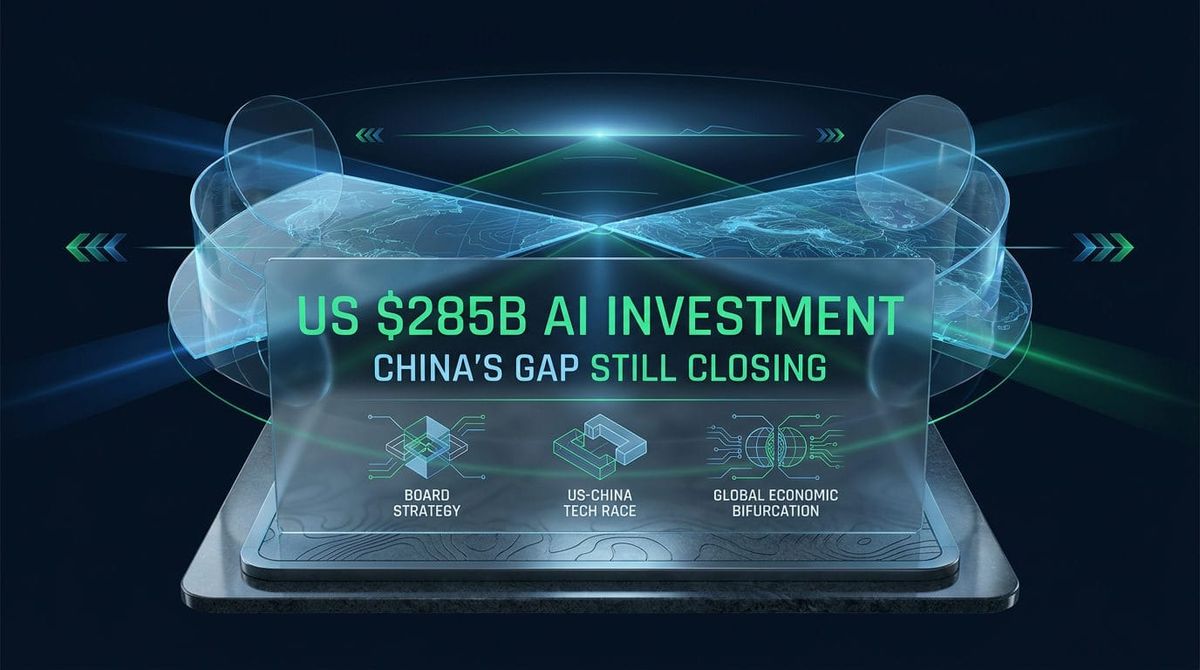
US Outspends China 23x, but AI Capability Gap Is Closing Fast
Despite significantly lower investment, China is rapidly closing the AI capability gap with the US through state-backed industrial automation.
The strategic landscape is being reshaped by a new global order, demanding boards navigate accelerating AI integration, geopolitical realignment, and a fundamental redefinition of leadership and talent.
📊 11 episodes across 9 podcasts
⏱ 443 minutes of intelligence analyzed
🎙 Featuring: Mohamed Younis, Joe Goldberg, Bethany Sensenig, Evan Epstein
|
The Big Shift
The strategic imperative for boards and leadership teams is no longer just about adapting to technological change but actively anticipating and shaping an increasingly bifurcated global economic order. While the immediate focus might be on AI's disruptive potential, a deeper analysis reveals a complex interplay between technology, geopolitics, and human capital that demands a holistic strategic response. China's aggressive, state-backed integration of AI into its physical economy through industrial automation is rapidly closing the capability gap with the U.S., despite significantly lower private investment (Alice Han on The Prof G Pod). This isn't just about competing technologies; it's about competing economic models and geopolitical influence.
This strategic divergence extends beyond national borders. The conversation highlights a growing divide between Western private sector-led AI development and China's top-down, industrial policy approach. The implications are profound, touching on everything from supply chain resilience to data sovereignty and even the future of work. As Yvonne Wassenaar (Technology Executive, Advisor, Board Director) noted on Boardroom Governance, boards face a stark choice: "The one thing that we know in the boardrooms that I sit, is that the sure path to death is to not do AI. And so AI might be risky, it might be unknown, it might be costly, but if we don't do it, we die." This sentiment underscores a new strategic reality where inaction is the gravest risk, forcing leaders to navigate an uncertain path while China redefines the terms of global technological leadership. This shift demands not just technological adoption, but a fundamental reassessment of market access, talent strategy, and regulatory engagement in a world increasingly defined by dual, often conflicting, technological and economic ecosystems.
"The U.S. spent about $285 billion on private AI investment in 2025 versus China, roughly 12.4 billion, about 23 times less than the U.S. but the capability gap between the two countries, despite the investment difference, is rapidly tightening."
— Alice Han, Host at Vox Media Podcast Network on The Prof G Pod with Scott Galloway
Why it matters: Boards need to move beyond viewing AI as a singular technology and recognize it as a core component of geopolitical competition and industrial policy. This necessitates a more sophisticated understanding of global supply chains, regulatory divergence, and the potential for a bifurcated technological future.
The Board Question: How are we recalibrating our strategic plan to account for divergent global technological ecosystems and the rise of state-backed industrial AI strategies, particularly from China, beyond mere private sector competition?
IDEAS IN BRIEF
① Strategic Clarity is Paramount for Corporate Divestitures.
Boards must distinguish between selling, divesting, or retaining a business, as each path offers different value, complexity, and risk, emphasizing that readiness creates optionality for successful corporate transactions (Joe Goldberg on BoardVision).
→ The Opportunity: Proactive portfolio rationalization, coupled with a clear understanding of strategic alternatives, allows boards to maximize value and minimize disruption in a dynamic M&A landscape.
② AI is a Complexity Multiplier, Not a Simplifier (Yet).
Contrary to popular belief, AI is currently mass-producing more options, decisions, and digital noise, outpacing human ability to comprehend or manage it, rather than simplifying work or life (Jim Vande Hei, CEO of Axios, on Masters of Scale).
→ The Implication: Leaders must implement rigorous "Confront, Delete, Amplify" strategies to combat cognitive fatigue and prioritize effectively, leveraging AI for non-journalistic tasks while building bespoke AI agents for complex issues like personalized healthcare.
③ Redefining Leadership Beyond Being "Right".
Effective leadership confidence stems from reframing the approach from a "right or wrong" mentality to one of strategic choices, encouraging a shift from "I have the best answer" to "we have the best answer" to foster collaborative problem-solving (Muriel Wilkins on Coaching Real Leaders).
→ The Imperative: Cultivating leadership that prioritizes collective intelligence and open dialogue will unlock better outcomes and enhance team engagement, especially in rapidly evolving environments.
④ The "Nepo Baby" Label Forces Strategic Self-Reflection on Privilege.
The sting of the term 'nepo baby' can be a valuable catalyst, compelling those with unearned advantages to confront systemic inequalities and consider how to leverage their privilege for positive impact, such as creating opportunities for others (Bryce Dallas Howard on Worklife with Adam Grant).
→ The Insight: Acknowledging and strategically deploying inherited privilege can transform perceived disadvantage into a powerful force for organizational and societal good, fostering humility and a commitment to broader impact.
⑤ Thoughtful Traditions Build Resilient Organizational Culture.
Adam Grant, who once believed "tradition is peer pressure from dead people," now advocates for thoughtful traditions as vital for building culture and strengthening values, fostering connection and shared identity within organizations (Adam Grant on Dare to Lead with Brené Brown).
→ The Strategic Move: Re-evaluating and intentionally designing traditions can reinforce core values, enhance employee engagement, and build a more cohesive and resilient organizational fabric, particularly in hybrid work models.
⑥ High-Performing Teams Master Time and Productive Disagreement.
"Super teams" avoid unnecessary meetings and set dedicated focus blocks, while also embracing productive disagreement as an opportunity to make better decisions, rather than a conflict to be avoided (Ron Friedman on Radical Candor: Communication at Work).
→ The Action: Leaders should institute practices that protect deep work and cultivate an environment where constructive challenge is seen as essential for innovation and better outcomes.
Signal Board
🔥 HEATING UP
• AI-driven cyber attack acceleration: AI is already enabling cyber attackers to operate at a speed and sophistication not humanly possible, making the next 12-18 months 'hellacious' for CISOs and board directors (Yvonne Wassenaar on Boardroom Governance).
• China's Fourth Industrial Revolution AI leadership: China is deploying industrial robots and fully automated factories at an unprecedented scale, leading the integration of AI into physical economy (James Kynge on The Prof G Pod with Scott Galloway).
• Board's Role in Sales and Divestitures Oversight: The board's oversight is crucial for ensuring strategic alignment, evaluating alternatives, and protecting the strategic framing of complex corporate transactions (Joe Goldberg on BoardVision).
🌱 ON WATCH
• Ke Huy Quan 🆕: His career resurgence, driven by the success of 'Crazy Rich Asians', signals a broader shift in industry representation and the power of external market forces to create opportunities (Ke Huy Quan on ReThinking).
• Refugee identity and overcoming stigma 🆕: Ke Huy Quan's journey of reframing his refugee experience from shame to pride highlights the power of narrative in shaping personal and professional identity (Ke Huy Quan on ReThinking).
• Confront, Delete, Amplify 🆕: This framework from Axios CEO Jim Vande Hei offers a structured approach to managing the increasing complexity and decision overload created by AI (Jim Vande Hei on Masters of Scale).
❄️ COOLING OFF
• The Yuan's limited role as global reserve currency: Despite China's growing economic influence, the CNY remains around 2% of global FX reserves, dispelling notions of its imminent displacement of the USD (Alice Han on The Prof G Pod with Scott Galloway).
• AI superintelligence extinction risks: While a concern, critics argue that performative safety efforts by AI founders distract from immediate, misuse-related risks and economic capture (George Hahn on The Prof G Pod with Scott Galloway).
• Asking 'Can I give you some feedback?': Ron Friedman argues this phrase is manipulative, suggesting that feedback should be proactive and embedded in regular communication rather than a formal, anxiety-inducing event (Ron Friedman on Radical Candor: Communication at Work).
THE TENSION
Is AI a net simplifier or complexity generator for individuals and organizations?
🔵 Perspective One: AI's promise is simplification, automating mundane tasks and enabling greater focus. Many view AI as the ultimate tool for efficiency, streamlining processes and reducing human effort, ultimately freeing up cognitive bandwidth. George Hahn (Host, Vox Media Podcast Network) noted on The Prof G Pod how AI is already "saving lives in healthcare and aiding in disaster prevention," implying a clear simplification of complex, life-critical tasks.
🔴 Perspective Two: For most, AI is currently a complexity creation machine, mass-producing options and decisions that lead to cognitive fatigue rather than liberation. Jim Vande Hei (CEO, Axios) strongly argued on Masters of Scale that "AI isn't simplifying your life. It's mass producing more options, more decisions, more noise." He suggests this overwhelms human capacity and requires new, rigorous frameworks for simplification.
The Strategist's Read: While AI has the potential to simplify, its current deployment largely increases complexity for human decision-makers, necessitating a proactive strategy to manage information overload and cognitive burden rather than assuming inherent efficiency gains.
The next strategic cycle will be defined by how decisively boards manage AI's dual nature: a geopolitical battleground and a personal cognitive burden.
Appendix
BoardVision: "A Board Playbook for Breakups" · 29 min · Featuring Mohamed Younis, Joe Goldberg, Bethany Sensenig
For Boards Considering M&A: This episode offers a critical framework for board oversight in divestitures and sales, emphasizing strategic clarity and risk assessment over mere execution. ▶ Listen · Apple Podcasts
Boardroom Governance with Evan Epstein: "Directing in the Age of AI | Yvonne Wassenaar & Alla Whitston" · 36 min · Featuring Yvonne Wassenaar, Alla Whitston
For Leaders Navigating AI Risk: Essential listening for understanding board-level AI oversight, the evolving cyber threat landscape, and the need for regulatory guardrails in an AI-driven world. ▶ Listen · Apple Podcasts
Coaching Real Leaders: "How Do I Lead with Confidence Without Always Needing To Be Right?" · 55 min · Featuring Muriel Wilkins, Carmen
For Developing Leaders: A practical guide to shifting leadership styles from individualistic "rightness" to collaborative problem-solving, improving team dynamics and personal effectiveness. ▶ Listen · Apple Podcasts
Dare to Lead with Brené Brown: "Rethinking Leadership, Work, and Human Connection in the Age of AI" · 37 min · Featuring Adam Grant, Will Anderson, Sean Rameswaram
For Culture Architects: Explores how thoughtful traditions and job crafting can foster human connection and build resilient organizational culture in a hybrid and AI-influenced work environment. ▶ Listen
Masters of Scale: "Let’s Kill Sh*t: Axios CEO on simplifying your work-life in the AI era" · 33 min · Featuring Jim Vande Hei
For Operationalizing Efficiency: Provides a "Confront, Delete, Amplify" framework for ruthless prioritization and managing cognitive overload in an AI-accelerated world. ▶ Listen · Apple Podcasts
Radical Candor: Communication at Work: "The Science Behind High-Performing Teams (with Ron Friedman)" · 56 min · Featuring Kim Scott, Ron Friedman
For Team Builders: Offers data-backed strategies for fostering high-performing teams, focusing on productive disagreement, effective feedback, and protecting dedicated focus time. ▶ Listen · Apple Podcasts
ReThinking: "Rethinking your career identity with Oscar winner Ke Huy Quan" · 49 min · Featuring Ke Huy Quan, Adam Grant
For Talent Development & Identity: An inspiring conversation on career pivots, resilience, and reframing personal narratives, offering insights into navigating professional identity shifts and leveraging relationships. ▶ Listen · Apple Podcasts
The Prof G Pod with Scott Galloway: "China Decode: The World Order Is Tilting Toward China (Series Finale)" · 44 min · Featuring Alice Han, James Kynge
For Geopolitical Strategists: A crucial deep dive into China's AI-driven industrial strategy, its expanding global influence, and the implications for the future world order and economic competition. ▶ Listen
The Prof G Pod with Scott Galloway: "No Mercy / No Malice: Oppenheimer, Inc." · 17 min · Featuring George Hahn
For AI Governance Stakeholders: A concise analysis of AI's dual-use nature, criticizing performative safety efforts, and advocating for robust, internationally coordinated regulation akin to nuclear non-proliferation. ▶ Listen · Apple Podcasts
The Prof G Pod with Scott Galloway: "The Case for Prenups, and Why Young People Aren’t Getting Married — ft. James Sexton" · 36 min · Featuring Scott Galloway, James Sexton
For Human Capital & Societal Trends: Explores the complex socio-economic factors driving declining marriage rates and the importance of practical legal frameworks in relationships, with broader implications for social cohesion. ▶ Listen · Apple Podcasts
Worklife with Adam Grant: "Bryce Dallas Howard on the realities of being handed a head start" · 51 min · Featuring Molly Graham, Bryce Dallas Howard
For Diversity, Equity & Inclusion Leaders: A candid discussion on acknowledging and strategically leveraging privilege, offering insights into the psychological impact of unearned advantages and fostering inclusive leadership. ▶ Listen · Apple Podcasts
Topics